Breitling Navitimer History: A Pilot's Slide Rule
In this article
The Breitling Navitimer is a Swiss pilot’s chronograph introduced in 1954, built around a circular slide rule and created in partnership with the Aircraft Owners and Pilots Association. It turned cockpit calculations into a wrist-level tool, and its early identity was inseparable from the pilots who requested it.
From Stopwatches to Cockpit Instruments
Léon Breitling established his workshop in 1884 in Saint-Imier, in the Jura Mountains of Switzerland. The firm focused on producing precise stopwatches and other timing devices for military and industrial fields as well as competitive sports. That foundation in measurement, not fashion, shaped everything that followed. Gaston Breitling took over in 1914, and the following year the company introduced the first independent pushpiece for chronographs. Gaston is also credited with the first wrist chronograph with an independent pusher separate from the crown, a detail that helped move timing from the pocket to the wrist. The evolution from pocket watch to wristwatch was not inevitable, as explored in How The Wristwatch Won Over The Pocket Watch.
In 1923 Breitling added a two-function system, and in 1934 came the second independent pushpiece. Willy Breitling ascended in 1927 at age 19, taking the chairman position while the company was located in La Chaux-de-Fonds. By 1938 the Huit Aviation Department had been established. A year later, the Royal Air Force became the first of several nations’ air forces to turn to Breitling as a provider of dashboard chronograph clocks. Aviation was no longer a side interest; it was the company’s direction. By the time the Navitimer arrived, Breitling had spent decades making timing devices for people who needed accuracy under pressure.
The Chronomat Sets the Stage
The Chronomat began with a conceptual foundation in 1940 and was unveiled the same year. It was the first timepiece equipped with a logarithmic scale on a rotating bezel, and it carried what is described as the world’s first slide rule bezel. Breitling patented it in 1941 and released it that year. The name meant “Chronograph for Mathematician,” and the watch used a bicompax dial. Its slide rule bezel was accompanied by tachymeter, pulsometer, and telemeter scales. Inside was a Swiss-made, manually wound Venus Caliber 175. The Chronomat proved that a bezel could be more than a timing accessory; it could be an instrument. That lesson directly informed the Navitimer. Its combination of a bicompax chronograph and a rotating logarithmic bezel was the blueprint for what came next.
A Watch for AOPA Pilots
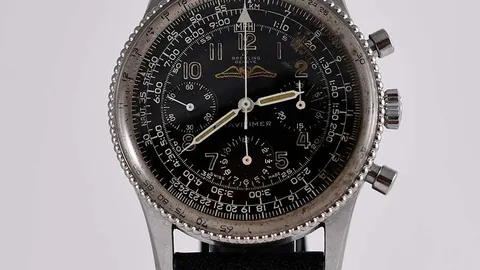
Breitling SA of Switzerland produced the Navitimer. Its name is a portmanteau of navigation and timer, which describes its purpose better than any marketing line. The watch was created in partnership with the Aircraft Owners and Pilots Association, which had been established in 1932. Initially, the Navitimer was available only to AOPA members, and the first dials carried the AOPA logo. Marketing went to AOPA members first, and for a time only pilots and aviation-industry insiders could buy one. The launch model measured 43 mm.
The original Navitimer used a Venus 178 movement. Its bezel rotated bidirectionally and had a beaded edge. The dial followed a three-register arrangement with subdials at 3, 6, and 9 o’clock. The Ref. 806, a foundational early reference, was powered by a hand-wound Venus 178 chronograph movement, wore a beaded bezel, and featured the AOPA wings on early dials. At 12 o’clock sat a stylized airplane silhouette emblem of AOPA. For a deeper look at how that slide rule works in practice, see Breitling Navitimer: The Wrist Calculator. In 1956 the Navitimer became publicly available, and the dial logo changed to the winged B Breitling logo.
The Cosmonaute and Spaceflight
In 1961 Scott Carpenter requested a Navitimer modified with a 24-hour dial instead of the normal 12-hour display. He wore the modified watch during a 1962 space flight. Breitling later sold the commercial version as the Cosmonaute Navitimer, which carried both Breitling and AOPA logos. The Ref. 809 Cosmonaute, credited to Carpenter in 1962, is recognized as the first Swiss wrist chronograph worn in space. That spaceflight connection gave the Navitimer a new kind of legitimacy: it was not only a pilot’s tool but a watch that had left the atmosphere.
Automatic Movements and the Quartz Crisis
The automatic era brought new engineering to the Navitimer. The Caliber 11 Chrono-Matic launched in 1969, and the Navitimer Ref. 1806 used it in a 48 mm case. But the industry was about to be shaken. The quartz crisis forced many traditional watchmakers to rethink everything, a shift explained in Automatic Vs Quartz: The Real Difference. In 1979 the Schneider family acquired Breitling following that crisis. That same year, Sinn licensed the 903, facing financial difficulties at Breitling. Sinn was not permitted to use the Navitimer name, but the 903 used the same design. The story of that German tool-watch lineage is covered in Sinn German Tool Watches: Over-Engineered Frankfurt History.
What the Navitimer Became
The Navitimer’s identity rests on a simple idea: put a circular slide rule on a chronograph and make it legible enough for a pilot to use. Over time, that idea survived changes in ownership, movements, and the market. The watch has been a military-adjacent instrument, a spaceflight artifact, a licensing template, and a collector’s reference. If you want to test how well you can identify this and other watches from their details, Watchdle offers a daily challenge at https://watchdle.com/play/. The Navitimer remains one of the clearest examples of a watch designed around a specific job rather than a generic idea of luxury. That focus is why it still reads as a tool rather than a piece of jewelry.
FAQ
What was the Breitling Navitimer Ref. 7806?
The Ref. 7806 was a 1970s Navitimer that used a manual-wind Valjoux 7740 movement with a date complication. It represents the model’s transition through a difficult decade for mechanical chronographs.
When did the Old Navitimer return?
Breitling reintroduced the Navitimer as the Ref. 81600 in 1986. It became known as the Old Navitimer and was powered by a hand-wound Lemania 1873 movement.
Which companies developed the automatic Navitimer chronograph?
Breitling, Dubois-Depraz, Heuer, and Hamilton co-developed the automatic Navitimer chronograph. Under the project name Project 99, it was introduced in 1969.