Rolex Day-Date History: 1956 Launch and Gold Legacy
In this article
The Rolex Day-Date arrived in 1956 as the first watch to display the date and the day of the week spelled in full, and it has been made only in gold and platinum throughout its production. That combination of a practical weekly calendar and precious-metal construction turned the model into a rare kind of wristwatch: a tool for reading the week, wrapped in materials that removed it from ordinary utility.
A Swiss Calendar Breakthrough in 1956
Rolex introduced the Day-Date at the Swiss Industries Fair Basel in 1956. The new model was an automatic watch from Switzerland. The automatic movement mattered because a full day-and-date display is a constant mechanical task; the watch had to keep the calendar advancing without daily winding. That might sound modest today, but spelling out the day in full was a different kind of ambition. The Day-Date was not just a calendar watch; it was a statement that a wristwatch could organize the week as clearly as it organized the month.
Day at Twelve, Date at Three
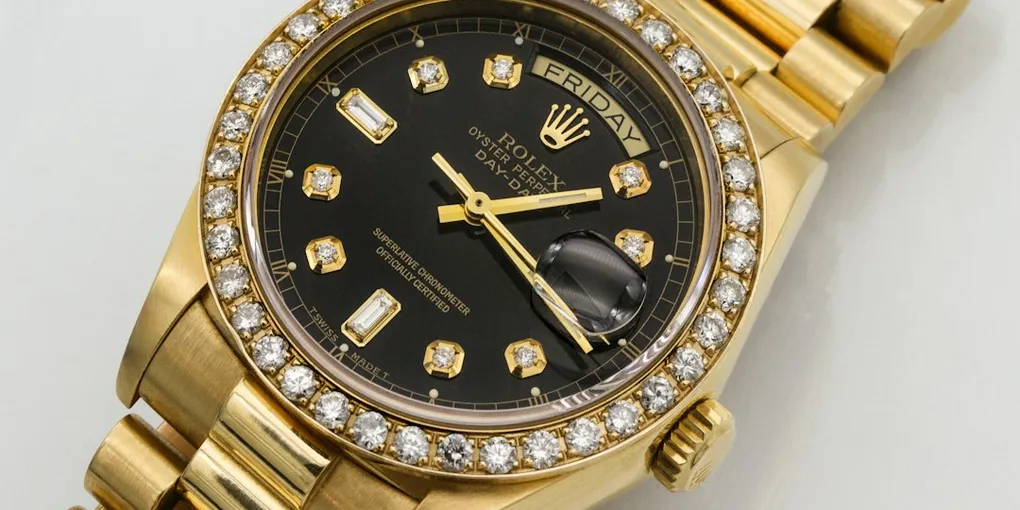
The dial architecture made that purpose immediate. The day of the week window sat at 12 o’clock. The date window sat at 3 o’clock. That split gave the wearer two separate pieces of information without crowding either one. Twelve o’clock is traditionally the most prominent position on a dial, and using it for the day window gives the watch a weekly headline. The date at 3 o’clock balances the composition, keeping the right side of the dial functional while the upper half carries the full word. The full day spelling also changed the character of the watch: Monday, Tuesday, Wednesday—the words themselves take up space, and the dial has to be designed around them. A mechanical watch with this much calendar information needs careful setting, especially when the date is changing; our guide to setting day and date on a mechanical watch safely covers the safe approach.
Automatic Winding and Swiss Origin
The automatic movement kept the Day-Date in step with the week. Swiss watchmaking provided the technical context, and the model carried that pedigree as part of its identity. The combination of an automatic caliber and a full day display gave the watch a practical rhythm: wear it, move with it, and the calendar advances. That rhythm is part of why the Day-Date has always felt like a daily companion rather than an occasional dress piece, even when its materials suggest otherwise.
The President Bracelet Arrives
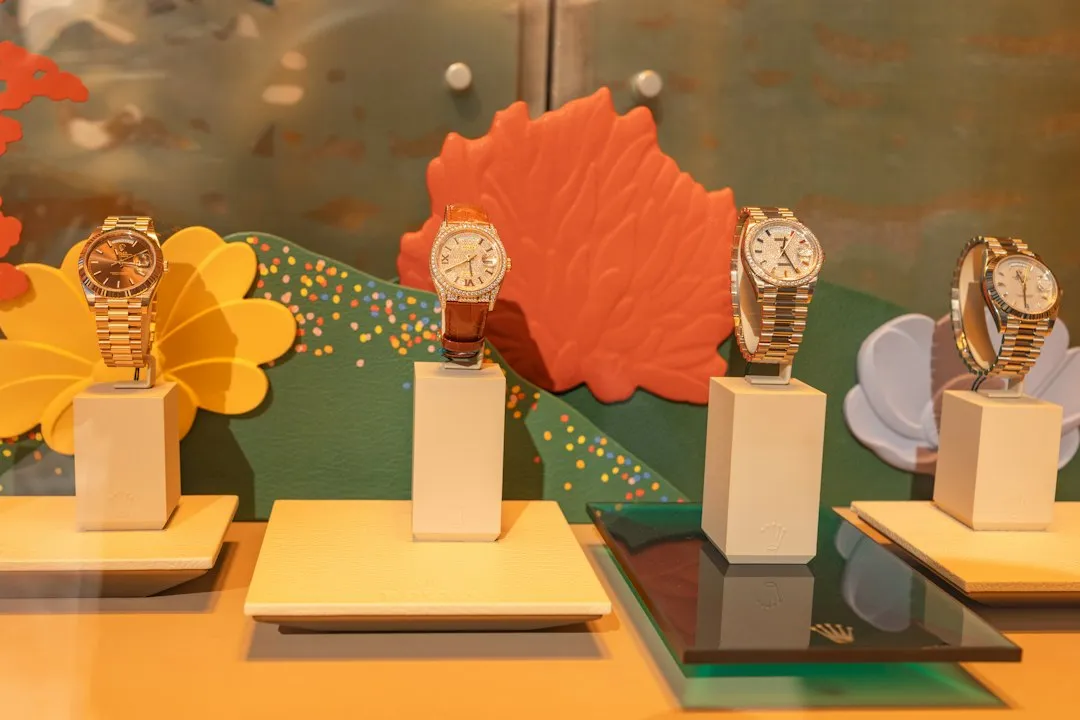
The President bracelet was created specially for the Day-Date and unveiled in 1956 at the model’s launch. It was not an existing bracelet adapted to a new case; it was part of the design from day one. The bracelet’s configuration placed three rounded links across the width of the band, a layout exclusive to the model. Its links are semi-circular. That geometry gives the President bracelet its soft, continuous profile, with light rolling across the links instead of sitting flat. The three-link arrangement across the width of the band is simple to describe but difficult to execute with the same visual rhythm; the semi-circular links need to sit close enough to feel continuous while still articulating.
From 1957 Naming to Official Status
The name arrived quickly. As early as 1957, the bracelet was referred to as the President Bracelet. Over time, that informal handle became the official name: President bracelet. The naming history is unusual because the bracelet became almost as famous as the watch it was made for. A bracelet with three rounded links and semi-circular shapes is not a generic accessory; it changes the watch’s silhouette completely, turning the head and band into one flowing piece. That is why the President bracelet is often the first thing people notice, even before they read the day.
The Gold-Only Rule and Its Materials
The Day-Date has been built exclusively of precious metals: 18 ct yellow, white or Everose gold or 950 platinum. That palette is not a trim option but the core identity of the line. Gold gives the watch warmth and weight; platinum gives it a cooler, more restrained presence. The use of 18 ct yellow, white or Everose gold or 950 platinum means the watch never leaves the realm of precious metals, no matter the color. The gold-only legacy is why the Day-Date occupies a separate place from steel sports Rolex models, even though it shares the crown. Where a steel tool watch can be worn hard and forgotten, the Day-Date asks to be noticed. If you want to test your eye for Rolex references, the daily challenge at Watchdle is a low-stakes way to do it.
Reference 1803 and the Classic Formula
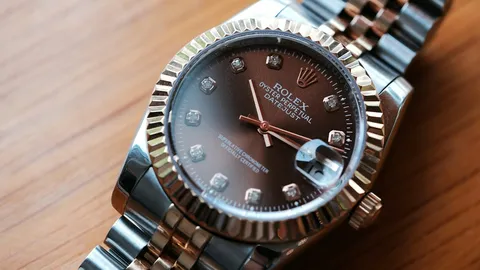
One reference crystallizes the classic Day-Date formula: Ref. 1803, with a gold 36mm case, a gold fluted bezel, and a gold President bracelet. Those three elements—case, bezel, bracelet—create a complete precious-metal object. The 36mm case size keeps the watch in traditional dress-watch territory, while the fluted bezel catches light and signals its Rolex heritage. The all-gold construction means there is no visual break between the head and the bracelet. Ref. 1803 is a useful anchor because it brings the case, bezel and bracelet into one package, showing how the Day-Date’s precious-metal identity works as a whole. Collectors chasing early references often start with our guide to buying a vintage Rolex.
‘The Presidents’ Watch’ in Advertising
Rolex advertising called the Day-Date ‘The Presidents’ Watch’. That phrase did not need to explain the watch’s mechanics; it sold an association with power, formality, and arrival. The advertising language around precious-metal Rolex watches is part of a longer story, as explored in How Watch Ads Sold Time And Status. The Day-Date’s gold-only materials and full day display made it easy to position as a watch for people whose schedules were public. It was a calendar for the corner office, not the factory floor.
FAQ
What were the earliest Day-Date references?
The earliest models were Ref. 6510 and Ref. 6511. The Ref. 6511 could be ordered in gold or platinum.
How many patents preceded the Day-Date?
Four patents were registered from 1950 to 1955 for timepieces featuring day and date indication. They laid the technical groundwork for the model’s eventual debut.
Was the Day-Date ever made in stainless steel?
Six examples of Ref. 6611 were made in stainless steel and offered as prizes to students of the Geneva school of Horology. This is the known exception to the line’s precious-metal rule.
Which materials has the President bracelet used, and who could wear it?
The President bracelet has been made only from 18 ct gold or 950 platinum. It was reserved exclusively for the Day-Date and precious metal versions of the Datejust. For the Datejust side of that story, see Rolex Datejust History: Origins and Evolution.