What Is A Fumé Dial On A Watch?
In this article
A fumé dial is a watch dial with a smoky colour transition, usually fading from a lighter centre to a darker edge. The name comes from French, where fumé means “smoked,” and the effect turns a flat surface into something that looks lit from within.
What the Gradient Is Actually Made Of
A fumé dial is not printed with one colour and left alone. The base is typically made of brass or gold, then the gradient is achieved through precise spraying or electroplating. Colour is applied in layers, with less pigment at the centre and increasing density toward the edge. After the colour work, several layers of transparent lacquer are added to protect the dial and enhance its depth. That lacquer is partly why a good fumé dial seems to have a glow beneath the surface rather than a simple fade across it. The same optical principle applies to crystals: anti-reflective coating can make or break how clearly you read a dial, especially when light hits at an angle.
Two common routes produce the effect. In a sprayed lacquer fumé, darker lacquer is sprayed onto a spinning dial so the colour builds up at the edges. In an enamel fumé, the dial is fired in a kiln at around 800°C in repeated layers until the gradient sets. That method is very different from a pie pan dial, where geometry and facets do the light work.
From Mid-Century Experiments to a 1960s Signature
Fumé dials date back to the mid-twentieth century, but the technique emerged around the 1960s. H. Moser & Cie was one of the first brands to perfect and popularise the finish. Its Endeavour Centre Seconds and Pioneer series have used shades such as Cosmic Green, Funky Blue, and Burgundy. A specific example is the H. Moser Endeavour Centre Seconds Concept Funky Blue, reference 1200-0215. It has a 40mm white gold case, an in-house automatic HMC 200 movement with roughly a three-day power reserve, and a sapphire crystal, with a retail price around 19,750 USD. That watch shows how a fumé dial can be the entire point of a design: no clutter, just colour shifting across a clean surface.
A Colour Range That Rewards a Closer Look
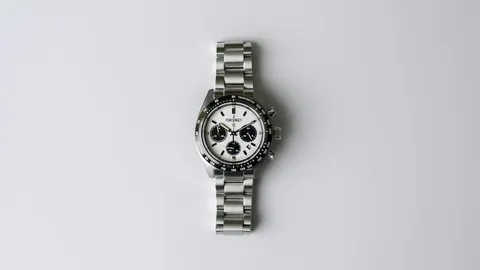
The palette is wider than the name suggests. Fumé dials can be brown, grey, black, blue, green, red, burgundy, gold, bronze, purple, teal, or smoky champagne. The colour at the edge can read almost black in low light, then open up to a brighter tone under direct light. That variability is why photographs often miss the effect. A fumé dial is best judged in person, where you can tilt it and watch the centre and edge change character. Unlike a panda dial, which depends on two stark contrasting zones, fumé works through continuous transition.
How Fumé Dials Appear in Modern Watches
Modern fumé dials turn up in everything from hand-finished enamel pieces to titanium sports watches. The anOrdain Model 1 Plum Fumé is a useful study: a 38mm steel case, a hand-wound Sellita SW210 regulated in-house with around 42 hours of power reserve, and a hand-fired vitreous enamel dial in plum fumé. Its retail price is around 3,800 USD, or about £2,950. At a very different price point, the Zenith Chronomaster Revival A385, reference 03.A384.400/385.C855, pairs a 37mm steel case with the El Primero 400 automatic chronograph, a 5Hz high-beat movement, and 50m water resistance, priced around 9,400 USD. Then there is the Christopher Ward The Twelve 40 Ti Astral Blue, reference C12-40ADC1-T00B0-B0. It uses a 40mm titanium case, a COSC-certified automatic Sellita SW300-1, and an Astral Blue gradient laid over pyramid guilloché, at around 2,295 USD on the bracelet. That last example is a reminder that fumé can sit on top of texture; guilloché patterns catch and scatter light beneath the gradient.
Because the dial changes with the light, strap choice becomes less obvious. A brown leather strap may warm up a grey fumé, while a blue rubber strap can push a blue gradient toward sport. The principles in this watch strap colour guide apply well here: pick a strap that supports the dial’s dominant edge colour, not just its centre.
Judging a Fumé Dial in the Metal
For resizing or swapping a strap, a strap replacement kit covers the basics.
In person, look at the transition rather than the colour alone. A well-executed fumé should look even all the way around, without a blotchy edge or a dead zone where the pigment stops. Check how the dial behaves at an angle, because the lacquer layers and any crystal reflections can hide or reveal the gradient. The finish is also a maintenance consideration: the protective lacquer is there for a reason, and a dial that has been opened or damaged may lose some of its depth. If you are playing a daily guessing game like Watchdle, fumé dials are a good reminder that colour is often the fastest clue. But the real pleasure is slower: the way a dial can look almost black at arm’s length and then reveal a bright centre when you move your wrist.
FAQ
Which colours can a fumé dial come in?
Brown, grey, black, blue, green, red, burgundy, gold, bronze, purple, teal, and smoky champagne are all possible. The list matters because the edge colour often sets the watch’s overall mood more than the centre does.
How does a sprayed lacquer fumé dial get its gradient?
Darker lacquer is sprayed onto a spinning dial, so the colour builds up at the edges. That mechanical method creates the fade without needing a separate ring or a printed transition.
What makes an enamel fumé dial different?
The dial is fired in a kiln at around 800°C in repeated layers until the gradient sets. The anOrdain Model 1 Plum Fumé uses a hand-fired vitreous enamel dial in plum fumé.
As an Amazon Associate we earn from qualifying purchases.