Guilloché On A Watch Dial: Engraved Patterns Explained
In this article
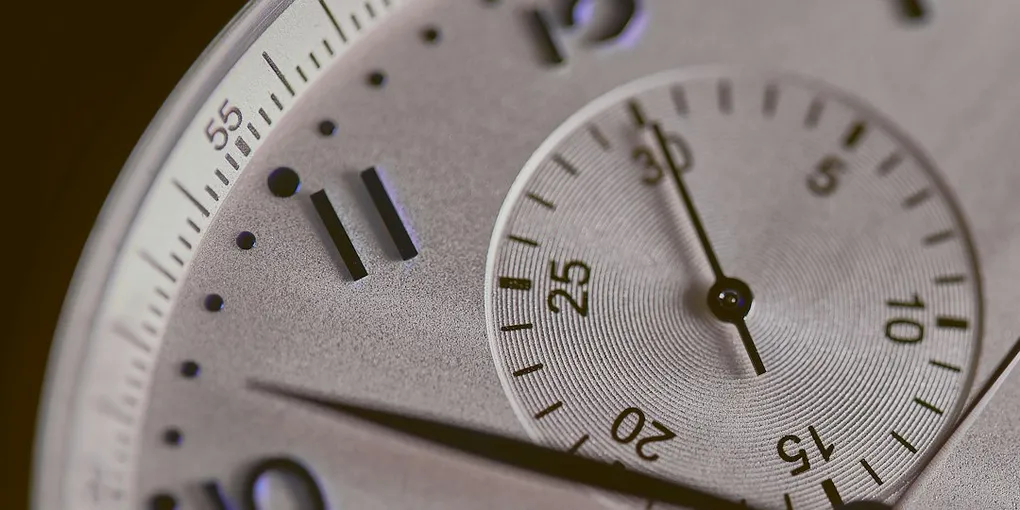
Guilloché is a decorative finish made of repetitive patterns engraved directly onto a watch dial, usually with a machine such as a rose engine, so the metal itself carries the design rather than a printed graphic. The result ranges from classic geometric designs to complex motifs, and its effect is to add depth and texture to the surface of the dial.
The Engraved Geometry Beneath a Dial’s Surface
A guilloché dial is not painted, stamped, or printed. Its construction is a decorative pattern engraved directly onto the dial, often using a machine. That distinction matters because the pattern belongs to the dial material: lines are cut into the surface, and the light responds to those cuts. The vocabulary can be broad—classic geometric designs sit alongside more complex motifs—but the underlying idea is repetition. The eye reads the repeat as rhythm, and the metal reads the repeat as texture.
The technique belongs to a wider craft called engine turning, or guillochage, defined as adorning wood or metal with intertwined lines. That practice goes back over five centuries. Its initial applications were soft materials such as wood and ivory before the method was adapted to metals. In watchmaking, the first application is dated to the 1680s, when Pierre Duhamel used it on a case in Geneva. Dials came later: Abraham-Louis Breguet popularized guillochage on dials, introducing it as early as 1786. Today guilloché is an integral aspect of watchmaking tradition, and the majority of traditional guilloché work is done on watches, watch dials, and other watch components such as oscillating weights.
How a Rose Engine Turns Metal Into Pattern
Guilloché engraving uses lines etched into the dial with a hand-operated machine such as a rose engine or a straight-line machine. The cuts are either circular patterns or straight lines, guided by rosettes or bars. In a straight-line engine, patterns are cut either vertically or horizontally. In engine turning more broadly, geometric patterns are cut into a rotating metal surface with a stationary cutting tool called a rose engine.
The work is not a matter of letting a machine do everything. A plate is affixed to the engine-turning machine, and variously shaped rotating wheels—rosettes—dictate the movement that generates diverse patterns. The artisan rotates the workpiece using a crank with one hand while guiding the cutting tool with the other. Cuts are meticulously repeated, combined, and sometimes intersected to create geometric motifs. Hand-guilloché demands years of expertise, concentration, coordination, patience, and skilful hands. It is time-intensive and unforgiving. An intricate dial can require a full day of labour and sometimes incorporates over 1,000 distinct cuts. Traditional guilloché main practitioners are likely fewer than 100 craftsmen in Switzerland. Mastery takes around five years according to Yann Von Kaenel. Modern workshops still use antique machines to engrave delicate patterns on metal watch components.
Tapisserie, Clous de Paris, and Other Collector Terms
Collectors use specific names for the repeats. Tapisserie is also known as the waffle pattern: a repetitive geometric style. Clous de Paris is also known as the hobnail pattern, a classic guilloché design featuring small pyramid-like structures. A sunburst finish is a radiant pattern emanating from the center of the dial, resembling sun rays. Other guilloché patterns include pavé de Paris, barleycorn or grain d’orge, waves, and checkerboard.
The Audemars Piguet Royal Oak, introduced in 1972, made Tapisserie part of its identity. The Royal Oak is a steel, automatic watch from Switzerland. Its Tapisserie pattern is available in Micro Tapisserie, Grande Tapisserie, and Méga Tapisserie sizes. The Petite Tapisserie pattern on Royal Oak Jumbo dials is crafted using a specialized engraving machine known as a guilloché copying machine. Audemars Piguet has approximately 30 such machines in dedicated workshops, derived from those created by Robert-Alfred Lienhard in La Chaux-de-Fonds in the late 19th century. The Tapisserie pattern is achieved through engraving with a mechanical lathe that replicates the pattern of a matrix by adjusting its size, combining engraving, guilloché work, and pantograph. For a deeper look at the watch that carried this texture into modern collecting, the Royal Oak FAQ is a useful companion.
For another dial construction that manipulates facets and light, see what a pie pan dial does on Omega’s faceted design. That comparison helps explain why guilloché is not just ornament: it changes how a dial reads across a room.
Dial Textures That Show the Range
The Rolex Cellini Dual Time Everose Gold 50525, introduced in 2016, uses a dial pattern called “Rayon flammé de la gloire” guilloché, commonly known as a sunburst guilloché pattern. The watch is made of Everose gold and uses the Rolex caliber 3180 movement. The Cartier Rotonde de Cartier Power Reserve, introduced in 2015, has a silver-coloured dial with a guilloché finish and Roman numerals. These examples sit at different points on the spectrum: one leans on a radiant, light-catching motif; the other pairs engraved texture with classical numerals.
For a close look at one watch built around this technique, see the Favre Leuba Chief Tourbillon Guilloché. The appeal is not only historical. Guilloché gives a dial a surface that shifts as the wearer moves, which is why it often appears on dress watches and on sports watches trying to balance toughness with refinement.
Reading Guilloché in Person
In person, guilloché is easiest to appreciate at an angle. Straight-on, the pattern may look flat; tilt the watch, and the cuts begin to catch and release light. That behaviour is the whole point of the texture. Because the dial’s surface is doing so much work, strap colour becomes part of the composition. A strap can either let the pattern dominate or pull attention toward the case and hands. The craft is not confined to Europe either; the USA is also listed as a location for guilloché practice.
If you want to train your eye for dial details, the daily challenge at Watchdle is a low-stakes way to compare layouts, textures, and finishes. You do not need a loupe to start noticing the difference between a printed grid and a surface that has been cut.
FAQ
Where does the word guilloché come from?
The etymology is unclear. One theory relates it to the name Guillot or Guilloche, an inventor of an engine turning machine, although this is not clearly documented. Another theory connects it to an old Italian word, ghiocciare, derived from Goccia, meaning drop or bead.
What is flinqué?
Flinqué is a process that begins by engraving geometric patterns on a dial using the guilloché technique. The engraved dial is then coated with translucent coloured enamel.
How does an artisan control a hand-guilloché pattern?
A plate is fixed to the engine-turning machine, and rotating wheels called rosettes dictate the movement that produces different patterns. The artisan turns the workpiece with a crank in one hand while guiding the cutting tool with the other.