Why Do Watches Say Swiss Made On The Dial?
In this article
A watch says Swiss Made because its maker chose to mark it after the watch satisfied Switzerland’s legal origin criteria, which cover the movement, casing, testing, and where production costs are generated. The phrase is a regulated claim, not a casual decoration.
A Protected Claim, Not A Decorative Flourish
Swiss Made is a label or marking used to indicate that a product was made on the territory of Switzerland. It is a geographical indication protected under Swiss and international laws and treaties. Its purpose is to demonstrate to buyers that the item was made in Switzerland and made to a certain standard. That standard is written into Swiss law. Unauthorized use can be judged counterfeit; customs may seize offending goods, and a producer can be sued. The wording was formally adopted in the late 19th century, but the meaning has always been tied to origin in accordance with criteria established by law. It means more than having an address in Switzerland or using a marketing argument. For a deeper look at how the term functions, what Swiss Made actually means is a useful companion.
The difference between a protected indication and a loose slogan is enforcement. A brand cannot simply decide that its watches feel Swiss enough and print the words. If the criteria are not met, the term is not available. That is why the label can carry weight with buyers who never read the legal text: it signals that a set of conditions was satisfied, not that a marketing department liked the sound of the phrase.
The Legal Checklist Behind The Dial
The dial may be where the words appear, but the qualification happens in the workshop, the testing room, and the accounting ledger. The rules are cumulative. A watch must satisfy several overlapping conditions rather than passing a single test.
Movement And Assembly
For a watch to qualify, at least 50% of movement components must be made in Switzerland. The movement must be assembled in Switzerland, and it must be tested by the manufacturer in Switzerland. Technical development must also be carried out in Switzerland. The movement itself must be Swiss. This is a threshold, not a demand that every single part come from one factory. The rules decide origin and assembly; they do not require a brand to make everything in-house. That distinction matters when you read marketing about in-house versus outsourced movements.
The 50% movement component rule is not a statement that the remaining parts are hidden or unimportant. It sets how much of the movement’s physical makeup must originate in Switzerland. Assembly and testing are separate requirements, which means a movement can contain a mix of components but still need Swiss hands to put it together and check it. Technical development in Switzerland adds another layer: the work of designing and developing the movement must also happen there. A brand can outsource parts, and the rules allow for that as long as the thresholds are met.
Casing, Testing, And Final Inspection
A qualifying watch must have its movement placed in the case and tested in Switzerland. By 1924, that casing and testing location was already part of the framework. The legal criteria also require the movement to be cased up in Switzerland and the final inspection to be conducted by the manufacturer in Switzerland. So the words on the dial point to a chain of work performed on Swiss soil, not just to a design office with a Swiss postcode.
Placing the movement in the case is not a trivial step. It is the moment when a movement becomes a watch, and the law ties that moment to Switzerland. Testing in Switzerland reinforces the point: the assembled watch is checked on Swiss soil. Final inspection by the manufacturer in Switzerland means the last look before the watch leaves the workshop also happens there. By 1924, the casing and testing location was already part of the framework, which shows that the concern with where the final assembly happens is not a recent marketing invention.
Where The Money Is Spent
Production cost is another gate. At least 60% of all production costs must be generated in Switzerland. That figure applies to the complete watch, not only the movement. By 1925, the sixty percent production cost requirement was part of the picture. This cost test is why a watch can have a Swiss movement and still fail to qualify as Swiss Made if too much of the overall manufacturing spend happens elsewhere. The rule is about the economic weight of Swiss work, not just the origin of one component.
The 60% production cost rule is often the hardest to visualize because it deals with money rather than parts. It asks where the manufacturing costs are generated, not just where the headquarters sits. A watch can have a Swiss movement, be cased in Switzerland, and still miss the mark if too much of the total production spend is incurred elsewhere. That is why the rule applies to the complete watch, not only the movement. By 1925, the sixty percent requirement was part of the picture. The result is a label that reflects the economic geography of production, not just a single component’s passport.
Why The Words Appear—And Why They Sometimes Don’t
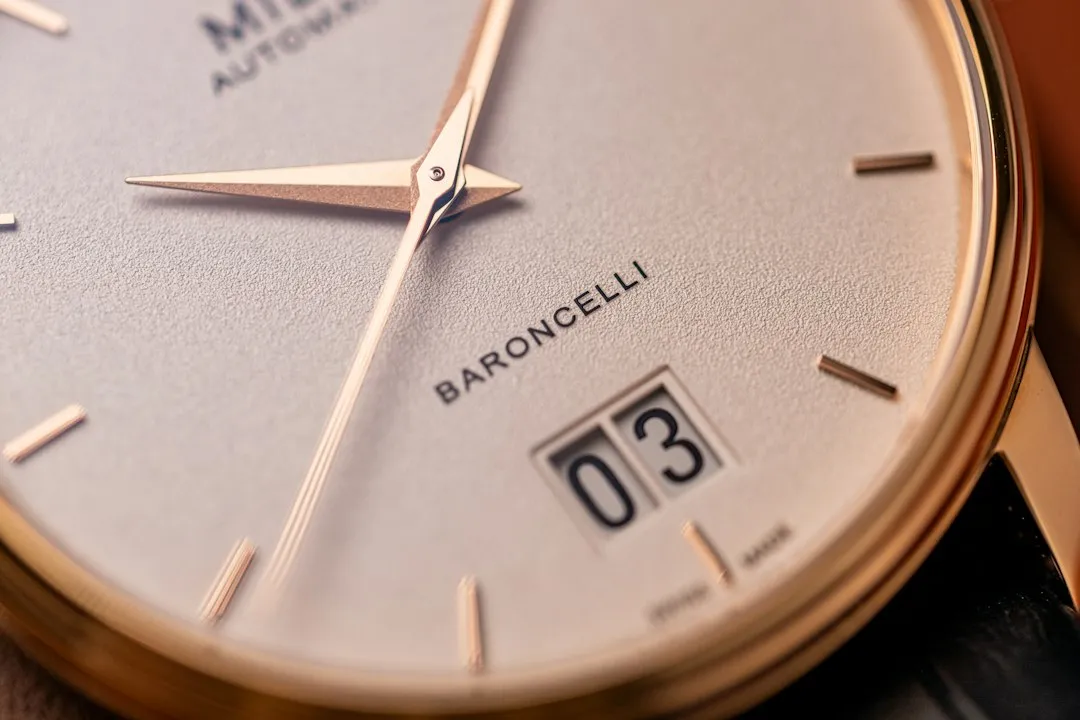
Once the criteria are met, a maker can choose to use the terms Swiss Made in marketing and on the dial. On watches that want to use the term in marketing, the phrase is usually—but not always—put on the dial. Some brands leave it off to allow more flexibility in manufacturing, for design reasons not to have words on the dial, or because they follow a higher standard of certification such as Chronometer testing. That last point can confuse buyers: an absence of Swiss Made does not automatically mean a watch is not Swiss. It can mean the maker simply chose a different path.
Marketing is the reason the dial matters. A watch that wants to use Swiss Made in its advertising will often carry the words on the dial, because that is where buyers look. But the law does not force every qualifying watch to announce itself. The choice belongs to the maker. Some skip the words to allow more flexibility in manufacturing, some prefer a clean dial without text, and some point to a higher certification such as Chronometer testing instead. For a buyer, this means the presence of Swiss Made is meaningful, but its absence is not proof of anything by itself.
Historical dials add another wrinkle. On some older watches, the word Swiss appears alone on the dial at the six o’clock position. Foreign watch brands may also use the Swiss Made label to give customers reassurance of the Swiss Made brand despite not being based in Switzerland. The label travels; the manufacturing criteria are what keep it meaningful.
What The Label Leaves Unanswered
Swiss Made is an origin claim, not a full specification sheet. It can sit on a dial above a movement that is finished in several ways, inside a case made from different materials, and attached to a bracelet or strap chosen for a dozen reasons. If you are comparing watches, the label belongs in the same mental folder as other regulated marks: useful, but not a substitute for reading the actual specifications. For a sense of how Swiss brands are performing in the market, the Swiss watch industry in 2026 is a separate story from what the dial says.
To see the small details up close, a watch loupe helps.
There is also a game-like pleasure in scanning a dial for these small bits of legal language. The daily challenge at Watchdle turns watch recognition into a quick habit, and it can make you notice details like dial text that you might otherwise skip.
FAQ
Does a watch company have to pay a fee to use Swiss Made?
No. Watch companies do not have to pay a fee so long as they follow the rules.
Does Swiss Made mean a watch is better made than one produced elsewhere?
No. It is not the case that Swiss Made means a watch is better than a watch made elsewhere. For a comparison of national approaches, see Swiss versus Japanese watchmaking.
What does the label leave unspecified about a particular watch?
By itself, Swiss Made does not specify materials, functions, or water resistance of a specific model. If water resistance is what you need to understand, water resistance ratings are the place to look.
How must the words Swiss movement be written on a dial?
If a watch carries the Swiss movement indication, the word movement must be written in full and in the same typeface, size, and colour as the designation Swiss.
As an Amazon Associate we earn from qualifying purchases.