Rolex Submariner: The Full History
In this article
A Dive Watch Arrives in 1953
The Rolex Submariner was introduced in 1953. It was a steel watch, automatic, and Swiss. Its first references, 6204 and 6205, were manufactured in 1953. The first model had a stainless steel case, black bezel, and black time-only dial. The bezel was a rotating 60-minute timing bezel. The dial used luminous material. Water resistance was 100m. The Submariner was introduced as a sports watch for diving in the mid-1950s. The ref. 6204 was presented to the public at Baselworld in 1954, and the first references were introduced to the public in 1954. The ref. 6200 was released in 1954.
Early References and Detail Changes
The initial references 6204 and 6205 started the line. The 6200 followed in 1954. From there, Rolex refined crown size and movements. The ref. 6536 had a small winding crown and caliber 1030. The ref. 6538 had a Big Crown. The ref. 6536/1 used caliber 1030 COSC. From the 6536/6538 onward, Submariner models used Mercedes hands and a depth index on the dial. The ref. 5508 had a Small Crown. The ref. 5510 had a Big Crown. Both appeared in the early 1960s. The ref. 5512 was a COSC version; the ref. 5513 was non-COSC. These changes matter because they show the Submariner was not frozen at birth. It was a tool watch being tested, adjusted, and specified.
1959: 40mm and Crown-Guards
In 1959, the Submariner’s case increased to 40mm. Crown-guards were added. That year is a clean dividing line. The 40mm case and crown-guards gave the watch proportions that would define it for decades. The change was not cosmetic in intent; it was part of making a dive watch more protected and more legible. The 1959 update sits alongside the earlier crown experiments: small winding crowns, Big Crowns, and Small Crowns across different references. By the end of the 1950s, the Submariner had moved from the first 6204/6205 pair into a more familiar shape.
1967 and 1969: Matte Dials, Date, and Gold
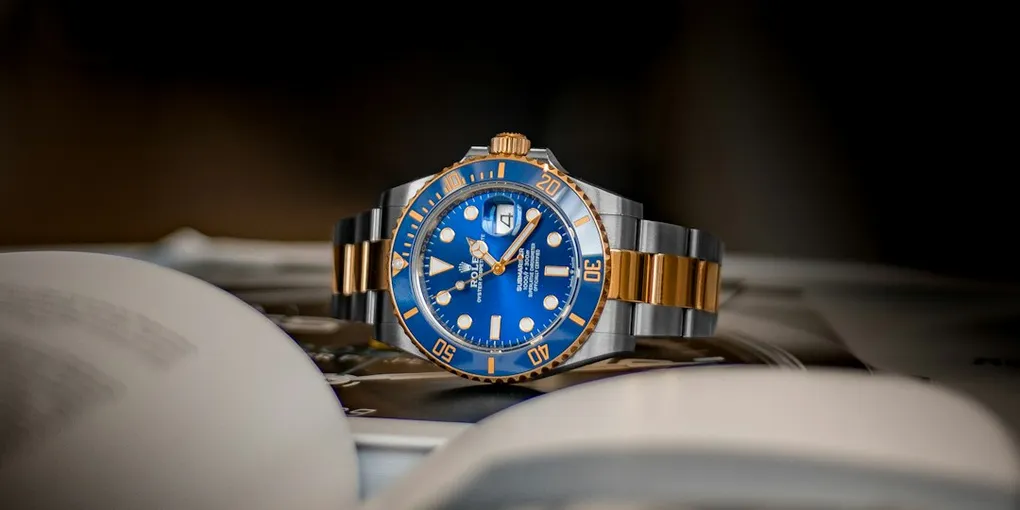
In 1967, Rolex switched the Submariner from gilt to matte dials. That change affected how the dial appeared. In 1969, Rolex introduced the Submariner Date. The Submariner Date was a steel watch with an automatic movement, made in Switzerland. In the same year, Rolex also produced the first gold Submariner. So 1969 was a double milestone: a date version joined the line, and gold entered the story. The Submariner Date did not replace the time-only Submariner; it expanded the family. The steel, automatic, Swiss formula remained, but now with a date option. The gold model pushed the Submariner in a different direction, showing that the same basic design could be rendered in a precious metal.
1970s and 1980s: Sapphire, Gloss, Two-Tone, 904L
In 1979, Rolex put the first sapphire crystal on a Submariner watch. Sapphire changed the way the watch presented over time, and it became another marker in the model’s evolution. In 1984, Rolex switched from matte to gloss dials with white gold markers. That same year, the first two-tone Submariner appeared. The two-tone model added another finish to the line, while the gloss dial and white gold markers changed the look of the dial. In 1988, Rolex switched from 316L to 904L stainless steel. The steel change is a technical detail, but it is central to how Rolex described its cases and bracelets in the years that followed. Each of these steps—1979, 1984, and 1988—moved the Submariner away from the earliest matte, gilt, and 316L-era watches.
2003: The Green Bezel
In 2003, the Submariner got its first green bezel. The reference tied to that change is 16610LV. A green bezel was a visible departure from the black bezel that had defined the first model. The 16610LV became a clear landmark: same Submariner language, different color. It also showed that collectors and buyers were paying attention to small reference-level differences. The green bezel did not change the core formula—steel, automatic, Swiss, rotating timing bezel—but it gave the line a new visual signature.
2010: Cerachrom and Super Case
In 2010, Rolex introduced the Cerachrom bezel and the Super Case design. Cerachrom brought a new bezel material to the Submariner. The Super Case design changed the case profile. For enthusiasts, 2010 is a major transition point because it altered the feel of the watch on the wrist and the look of the case. The rotating 60-minute timing bezel remained part of the design, but the bezel material and case shape moved forward. The Submariner was still a dive watch, still automatic, still Swiss, but the modern era had a different set of visual cues.
2020: 41mm and Redesigned Lugs
In 2020, the case increased to 41mm, and the lugs were redesigned. That year continued the pattern of significant case updates. The earlier 1959 change had set the case at 40mm; 2020 moved it to 41mm. The lug redesign changed the transition from case to bracelet. These changes were not isolated. They followed the Cerachrom and Super Case era and represented the latest stage in the Submariner’s sizing and case architecture. The current water resistance is 300 meters (1000 ft). That figure sits far above the 100m water resistance of the early Submariner, and it shows how far the model has come from its first references.
Why the Timeline Matters
The Submariner’s history is not just a list of dates. It is a sequence of decisions about crowns, cases, dials, bezels, crystals, and steel. The watch began in 1953 as a steel, automatic, Swiss dive watch with a rotating 60-minute timing bezel and a luminous dial. It had 100m water resistance. Its first references, 6204 and 6205, were manufactured in 1953 and introduced to the public in 1954. The ref. 6204 was presented at Baselworld in 1954. The ref. 6200 followed in 1954. From the mid-1950s, it was introduced as a sports watch for diving. Then came the 1959 40mm case and crown-guards, the 1967 matte dials, the 1969 Submariner Date and first gold Submariner, the 1979 sapphire crystal, the 1984 gloss dials with white gold markers and first two-tone, the 1988 904L steel, the 2003 green bezel ref. 16610LV, the 2010 Cerachrom bezel and Super Case, and the 2020 41mm case with redesigned lugs.
The details are specific, but the through-line is simple. The Submariner stayed a steel, automatic, Swiss watch for diving while it absorbed new materials and proportions. It kept the rotating 60-minute timing bezel and luminous dial as part of its core identity. The Submariner Date added a date option in 1969 and remained a steel, automatic, Swiss watch. The gold and two-tone models showed that the design could move beyond one metal. The sapphire crystal, gloss dials, white gold markers, 904L steel, Cerachrom bezel, Super Case, and 41mm case all became part of the ongoing story.
For anyone tracing the full history, the key is to separate the constants from the changes. The constants include the 1953 introduction, steel, automatic movement, Swiss origin, rotating 60-minute timing bezel, luminous dial, and the early 100m water resistance. The changes include the 1959 case and crown-guards, the 1967 dial switch, the 1969 Date and gold, the 1979 sapphire crystal, the 1984 gloss dials and two-tone, the 1988 904L steel, the 2003 green bezel, the 2010 Cerachrom and Super Case, and the 2020 41mm case and redesigned lugs. Put together, those facts tell the full history without needing to dress it up.
Think you know your watches? Test yourself in today’s challenge at Watchdle.