Rolex Datejust History: Origins and Evolution
In this article
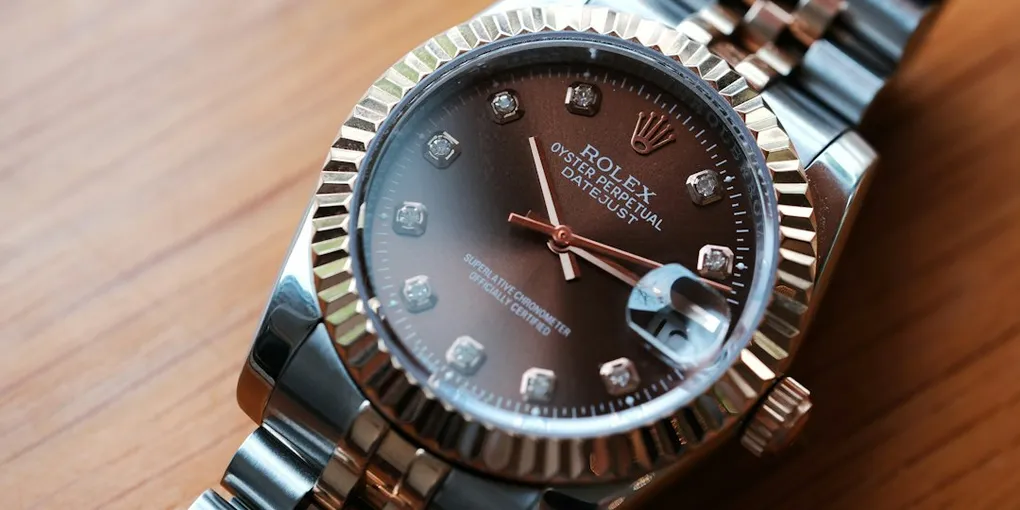
The Rolex Datejust arrived in 1945 as Rolex’s 40th-anniversary watch and became the first self-winding chronometer wristwatch to indicate the date in a window on the dial. It remains one of Rolex’s oldest collections of watches that still remain in production today.
The First Reference: 4467
Rolex introduced reference 4467 in 1945 to celebrate the company’s 40th anniversary. The watch was made of solid 18 karat yellow gold and wore a 36mm Oyster case with a domed or “Big Bubbleback” case back. A coin-edge fluted bezel surrounded the dial, which held a date window at 3 o’clock without a cyclops lens. Inside ran calibre 710, and the watch sat on a Jubilee bracelet created specifically for the Datejust. Rolex initially released only 100 pieces, though around 1,000 examples were ultimately produced between 1945 and 1949, each rated to 100 metres of water resistance.
Steel, Rolesor, and the Dial Name
References 5030 and 5031 followed in the 1950s and were produced from 1949 to 1950. They expanded the range into stainless steel and Rolesor, including an all-steel option. During this era the “Datejust” name actually started to be printed on the dial. Unlike Rolex’s professional tool watches, the Datejust was not specifically designed or intended for one particular sport, environment, or lifestyle activity.

The Case and Movement Context
The Oyster case had first appeared in 1926, well before the Datejust, and its development is detailed in the history of the Rolex Deepsea. Rolex built the Datejust in Switzerland as an automatic, analogue watch. Those curious about how self-winding mechanisms compare to quartz can read the breakdown of automatic versus quartz movements. The wristwatch had already eclipsed the pocket watch by the time Rolex launched the Datejust, a shift traced in the history of how the wristwatch won over the pocket watch.
Bracelets and Dial Details
The Jubilee bracelet was originally considered as a name for the watch itself but ultimately designated only the five-piece metal-link bracelet. Rolex later added the Oyster bracelet to the Datejust lineup, giving the model two metal-link options. Rolex later introduced a cyclops lens to magnify the date.
Reference Series and Crystal Changes
The 160x series arrived in the late 1950s with the Caliber 1560 movement. By then the Datejust name had become a permanent fixture on the dial, and the hands, bezel, hour markers, and crystal had taken forms still present today. The 160xx series followed in the late 1970s with the Caliber 3035 movement and a quickset date feature. These watches kept a 36mm case diameter, used an acrylic crystal, and featured a completely flat dial surface. Reference 16013 represented the classic Rolesor look, pairing stainless steel and yellow gold with Rolex’s iconic fluted bezel. The 162xx series appeared in 1988 with an updated Caliber 3135 movement and a scratch-resistant synthetic sapphire crystal. Anyone researching vintage examples should consult the guide on what to look for when buying a vintage Rolex before committing to a reference from these periods.
The Turn-O-Graph and Rotating Bezel
Rolex developed the Monomoter in 1953 as a Datejust variant with a rotating bezel marked to 60 minutes. Renamed the Turn-O-Graph, it became the first Rolex with a rotating bezel and served as the basis for the Rolex Explorer, Rolex Submariner, and Rolex Sea-Dweller. Like the Datejust, it was built in steel, ran on an automatic movement, and came from Switzerland. The connection to the Submariner is explored in the history of the Rolex Submariner through six decades.
Datejust II
Rolex unveiled the Datejust II in 2009. It offered a 41mm version alongside the standard 36mm model, and reference 1163xx ran on the Caliber 3136 movement. The Datejust II was fitted exclusively with an Oyster bracelet.
Datejust 41
The Datejust 41 arrived in 2016. It used a 41mm diameter case with smaller indexes and a thinner bezel. Materials included stainless steel and two-tone stainless steel with 18k yellow or 18k everose gold, and buyers could choose between Oyster or Jubilee bracelets.
Modern Calibers and the Current Range
Caliber 3235 succeeded the Caliber 3135 by replacing more than 90% of its predecessor’s parts. It includes the Chronergy escapement, delivers a 70-hour power reserve, and keeps the same dimensions as the movement it replaced. Rolex has also made ladies’ and mid-sized versions available, keeping the collection open to different wrist sizes. As of 2019 the Datejust lineup spanned 28mm, 31mm, 34mm, 36mm, and 41mm sizes. Materials ran from full stainless steel to two-tone gold in yellow, Everose, or white paired with steel, and up to solid gold cases and bracelets in yellow, Everose, and white. If you enjoy matching references to models, the daily puzzle at WatchDle offers a quick test.
FAQ
When did Rolex introduce an instantaneous date change?
Early Datejust models shifted the date gradually shortly before midnight, but Rolex introduced an instantaneous change beginning in 1955.
How does the Turn-O-Graph relate to the Datejust’s tool-watch legacy?
Introduced in 1953 as the Monomoter, the Datejust variant became the basis for the Rolex Explorer, Rolex Submariner, and Rolex Sea-Dweller. The US Air Force’s Thunderbird aerobatic team was issued the model, which picked up the Thunderbird nickname.
What happened to the Lady-Datejust 26mm?
Rolex replaced the 26mm model with a newer 28mm variant announced at Baselworld 2015, powered by the Caliber 2236 movement.
How did the Datejust 41 differ from the Datejust II?
The Datejust 41 kept a similar-sized 41mm case as the Datejust II but used smaller indexes and a thinner bezel, while offering a choice of Oyster or Jubilee bracelets instead of the Datejust II’s exclusive Oyster fitting.