Why Do Some Watches Have A Cyclops Date Magnifier?
In this article
Some watches have a cyclops date magnifier because the date mechanism’s fine workings force the date to be small, and the lens compensates by making that small number more visible. Rolex introduced the first date magnifier and uses 2.5X magnification on many of its models.
That explanation is easy to accept once you look closely at a date window. The cyclops is not random decoration. It is a small magnifying lens positioned above the date window on many Rolex watches, and it solves a legibility problem created by tiny mechanical parts.
The Mechanical Case For Magnification
The Datejust arrived in 1945 as a steel automatic Swiss watch and is credited as the first mechanical wristwatch with a date complication. It originally came without a magnifier. That detail matters because the first version proved the usefulness of a date on the wrist, but it also exposed the challenge: a calendar display has to fit into a dial already occupied by hands, markers, and branding. A larger date would demand more room and change the proportions of the watch. A smaller date keeps the mechanism cleaner but can be harder to read at a glance.
The cyclops answers that problem by sitting over the aperture and enlarging what lies beneath. It creates a visible bubble in the crystal, a single round interruption that draws the eye. If you have ever set a date without disturbing the mechanism, you know the date function has its own etiquette. The caution around [changing a date near midnight] is part of living with a calendar watch, and the cyclops is part of living with a small one.
From Patent To Production
Rolex filed a Swiss patent application for the magnifier in 1952. The first watch to receive it was the Datejust in 1953. The date complication had already been established; now the readability fix arrived.
The Day-Date appeared in 1956 as a gold automatic Swiss watch and placed its Cyclops over the date window at 3 o’clock. That position became familiar: a lens at three, the date centered beneath it, the rest of the dial left to hands and markers. Later conveniences such as [quick-set date] made changing the date easier, but they did not remove the need to read it. A magnifier is about daily use, not just technical novelty.
Not Every Watch Wanted One
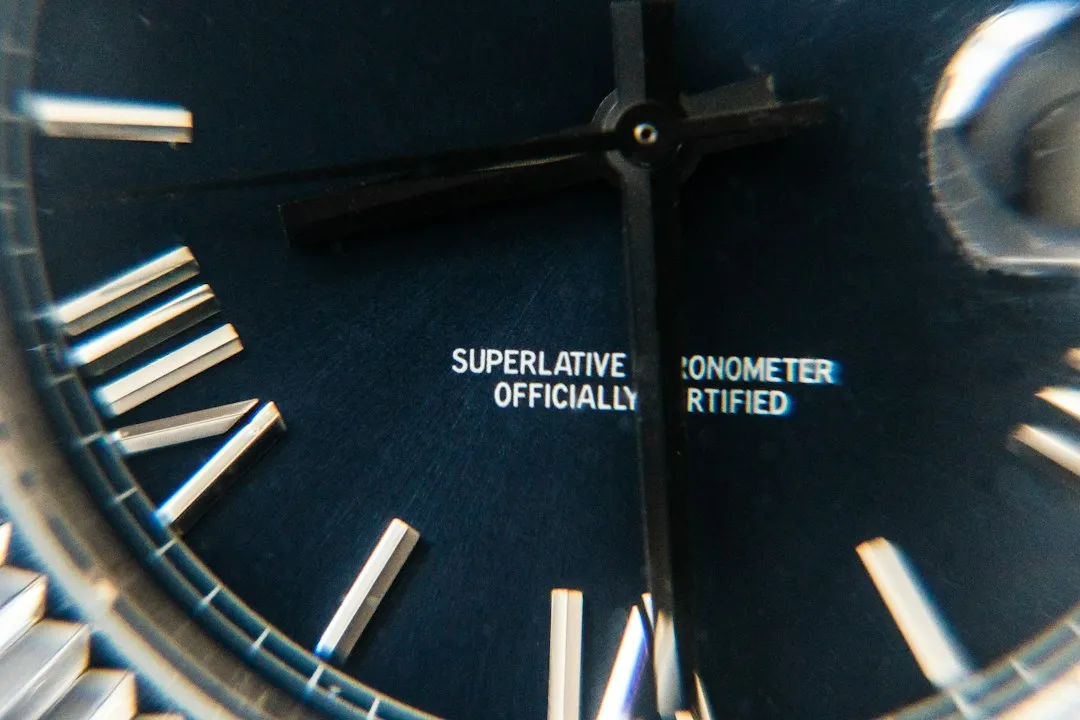
A cyclops is not automatically included on every watch with a date. On the GMT-Master ref. 6542, the magnifying lens reportedly cost extra. On the GMT-Master ref. 1675, buyers could choose a regular crystal without a Cyclops, and that option continued into the early 1970s. The [GMT-Master’s travel-focused history] makes those choices especially interesting, because a second time zone and a date window already asked a lot from a small dial. Some owners preferred an unobstructed crystal; others wanted the date magnified. The fact that both existed says the cyclops was never merely a default. It was a feature with fans, critics, and price implications.
Plexiglas To Sapphire
Early versions were not separate pieces glued on top. The original Rolex Cyclops was formed together with the watch crystal from a single piece of Plexiglas. That construction changed over time. Modern Rolex Cyclops lenses are made from sapphire and bonded to the exterior of the watch crystal. The ref. 1530 and 1630 were the first models given a sapphire cyclops. Today’s Rolex Cyclops lenses also have double anti-reflective coating, which helps explain why they can magnify without turning into a distracting glare magnet. The [anti-reflective coating] is invisible but vital here: a lens that catches light is worse than no lens at all.

Which Watches Wear The Lens
Across the Rolex catalog, the Cyclops appears on models such as the Datejust, Day-Date, GMT-Master II, Explorer II, Submariner Date, Yacht-Master, and Sky-Dweller. The Sea-Dweller has one, though that was not always the case. Rolex watches without date windows have no need for a lens at all. Examples include the Daytona, Explorer, Oyster Perpetual, Milgauss, and no-date Submariner. There is nothing to magnify.
On the GMT-Master II ref. 126720VTNR, often called the Sprite, the crown, date window, and Cyclops sit at 9 o’clock, a mirror-image layout that changes how the lens reads on the wrist. Elsewhere in the industry, Seiko routinely puts a Cyclops on its watches, so the idea is not confined to one Swiss brand.
Collectors notice magnification quickly. Fake Rolex watches often use 1.5X, and that difference can make a counterfeit look subtly wrong: the date is enlarged, but not to the expected degree. If you enjoy spotting those details, [spotting a counterfeit Rolex] can train your eye for the shape, position, and clarity of the lens. The same attention applies when browsing real watches. A cyclops can make a date instantly legible, or it can create a bright edge that distracts from the dial. That is why some people seek out models without it, while others consider a Rolex without a Cyclops oddly incomplete.
If you want to test your own eye for the feature, a round of Watchdle turns watch details into a quick guessing challenge.
Why The Cyclops Endures
The cyclops endures because the underlying problem has not disappeared. Mechanical watches still pack tiny date discs and fine workings into limited space. A larger date display is not always possible without changing the movement, the dial, or the proportions of the case. A lens offers a different solution: leave the mechanism small, then enlarge the result for the wearer. It is an elegant cheat, visible every time you glance at the date.
The feature also has a strong identity. It is associated with Rolex, named after a mythological creature, and recognizable across a room. For some, that bubble is a flaw; for others, it is the detail that makes a Datejust or Submariner Date feel like itself. Watches are full of such trade-offs. A crown guard can make a case bulkier but protect a crown. A bracelet can add weight but improve security. The cyclops does something similar: it accepts a small interruption in the crystal’s surface to solve a very human problem. A date is only useful if you can read it.
FAQ
When did the first Cyclops appear?
Rolex filed a Swiss patent application for it in 1952 and first introduced it on the Datejust in 1953. That watch had originally arrived in 1945 without a magnifier.
Are all Rolex date watches fitted with one?
No. The Deepsea is the only current Rolex watch with a Cyclops-free date display. A date window can exist without the lens.
Why is it called a cyclops?
The name comes from the one-eyed giants of Greek mythology. The single round lens above the date window makes the reference easy to understand.