Rolex Deepsea: The Full History
In this article
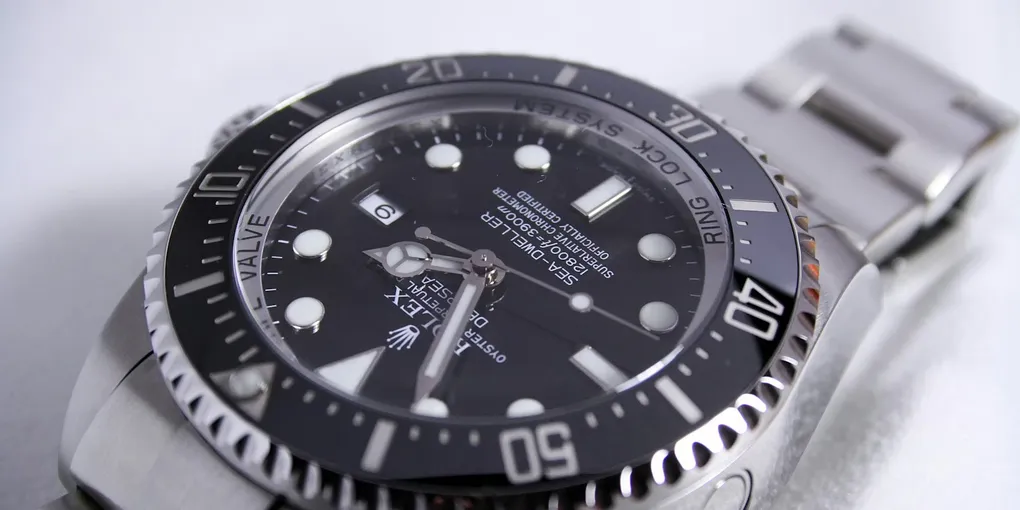
In 2008, Rolex did something that stunned purists who thought the Submariner was already more than enough watch for a wet weekend. They dropped the Rolex Deepsea, reference 116660. This was not a mild update to an existing dive watch. It was a 44mm chunk of Swiss engineering built to survive pressures that would turn a human being into a grease spot. Rolex skipped any polite preamble and built a mechanical instrument rated to a ridiculous 3,900 meters, or 12,800 feet. If you wore one to a boardroom meeting, it looked like a manhole cover strapped to your wrist. If you strapped it to the outside of James Cameron’s submersible, it worked. That is the duality of the Deepsea, a watch that makes zero compromises for the sake of dress cuffs.
Engineering the Ringlock System
The problem with making a watch water-resistant to extreme depths is simple physics. Water pressure wants to crush the crystal and caseback into the movement. Rolex solved this in 2008 not by making the sapphire crystal two inches thick, which would distort the dial, but by inventing the Ringlock System. This internal architecture consists of a nitrogen-alloyed stainless steel support ring, a domed 5.5mm sapphire crystal, and a grade 5 titanium caseback. When the ocean tries to compress the watch, the water pressure actually pushes the crystal and caseback tighter against this central compression ring. The harder the ocean pushes, the better the seal holds. It is a brutally effective mechanical solution. The case also dispensed with the traditional helium escape valve placement, integrating it seamlessly into the side of the case alongside the Ringlock branding engraved directly onto the rehaut.
The D-Blue Dial and Cameron Connection
By 2014, Rolex needed to freshen up the reference 116660 and tipped their hat to filmmaker James Cameron and his historic solo dive to the bottom of the Mariana Trench. They released the D-Blue dial variant, featuring a color gradient that shifts from brilliant royal blue to bottomless black. This visual effect mirrors the transition from light to dark as a diver descends into the midnight zone. The reference number transitioned to 126660 in 2018, and later to 136660, bringing updates under the hood. Rolex fitted the newer iterations with the in-house caliber 3235, boasting a 70-hour power reserve, the Chronergy escapement, and a wider bracelet to balance the massive case proportions. Purists argued about the 44mm size and the thick profile, but collectors chased the D-Blue because it offered a rare splash of emotion on an otherwise utilitarian slab of steel.
Crossing Into Solid Gold
For years, the Deepsea remained strictly a stainless steel affair, worn by people who actually used tool watches or simply liked heavy wrist presence. Then came 2024, and Rolex broke their own rules by releasing the Deepsea in solid 18k yellow gold, reference 126683 or rather 136668LB. This model paired the massive 44mm architecture with a shimmering blue lacquer dial, a Cerachrom ceramic bezel insert, and a matching gold Oyster bracelet equipped with the Glidelock extension system and Fliplock extension link. Weighing in at well over 300 grams, this version transformed the Deepsea from an pure industrial tool into an absurd, unapologetic statement piece. It proved that Rolex viewed the Deepsea not just as an experimental diving footnote, but as a permanent pillar of their catalog.
Why the Deepsea Matters Today
If you own a Deepsea, you know it requires a certain wrist real estate and a high tolerance for bumping it into doorframes. It lacks the understated vintage charm of a reference 5513 Submariner, and it will never slide smoothly under a tailored shirt cuff. Yet it remains one of the most mechanically honest watches Rolex makes. It is an over-engineered monument to depth ratings that 99 percent of owners will never test beyond a hotel swimming pool. But that is the point of collecting heavy-duty mechanical watches. We do not buy them for what we do; we buy them for what they can do.
Play today’s watch at .