Audemars Piguet Royal Oak: The Full History
In this article
The Audemars Piguet Royal Oak is a Swiss automatic steel wristwatch introduced in 1972, designed by Gérald Genta and launched as reference 5402. Its octagonal bezel, integrated bracelet, and blue petit tapisserie dial made it a radically different kind of luxury watch—one that turned a sporty steel case into the main event.
Gérald Genta and the 1971 Brief
A Designer’s Background
Gérald Genta was born in Geneva in 1931 to an Italian father and a Swiss mother. That background placed him between two design cultures, and the Royal Oak would become one of the clearest expressions of that mix. The Swiss side of his world understood precision and finishing; the Italian side could bring a more dramatic, sculptural approach. The Royal Oak reflects both. Its finish is exacting, but its shape is theatrical. The watch does not whisper. It makes a statement from across the room, yet it rewards close inspection.
He designed the watch for Audemars Piguet in 1971, on the eve of the 1971 Basel fair. The timing tells you something about the project: it was not a slow, decades-long evolution but a concentrated act of design that arrived just before the industry’s most important stage.
The Helmet and the Patent
The inspiration for the Royal Oak was a traditional diver’s helmet. That is not the usual source for a luxury watch. It explains the protective, industrial feel of the case and bezel, and it links the Royal Oak to a longer story of underwater equipment becoming wristwear—a story explored in the history of the dive watch. Genta filed U.S. Patent 3.756.017 for the design. The patent marked the shape as something worth protecting, not just a passing styling exercise.
Basel 1972 and the Launch
The Show and the Case
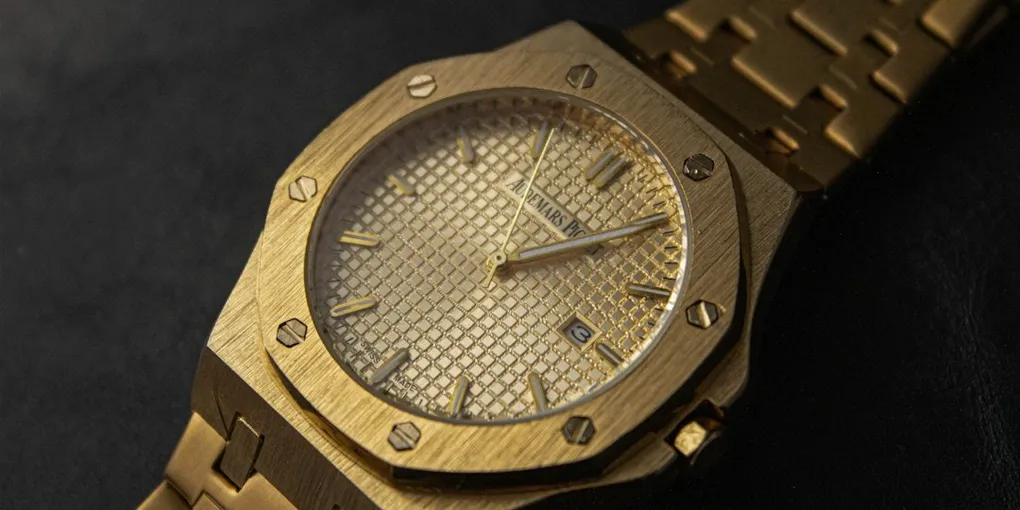
The watch arrived at Basel in April 1972, during the annual Swiss Watch Show that was later renamed BaselWorld. Its case measured 39 mm in diameter and just 7 mm slim. That combination gave the Royal Oak a wide, flat presence without the thickness that often comes with a complex sports watch. The 39 mm diameter and 7 mm height are easy to list but harder to visualize. Together they produce a watch that sits wide and flat, with a silhouette that feels more architectural than rounded.
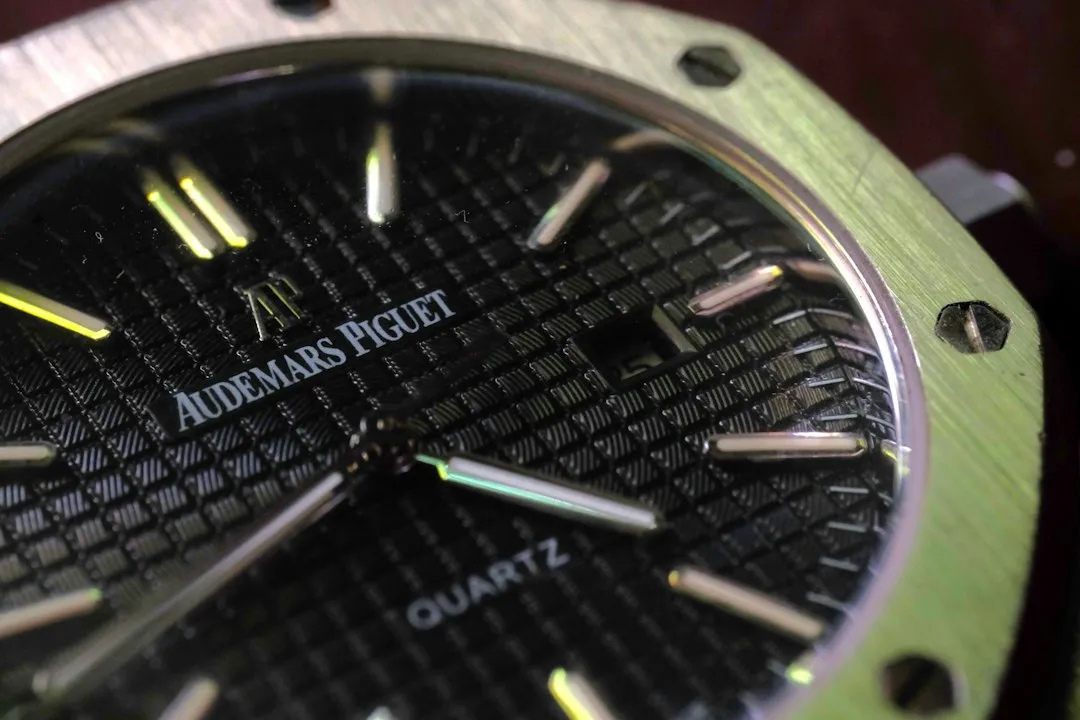
The bezel was secured by eight visible hexagonal gold screws. Those screws were not hidden on the back or buried under the dial; they were part of the front design, turning the bezel into a mechanical composition rather than a smooth frame. They are functional-looking, even if their role is as much visual as structural. By placing them on the front, Audemars Piguet made the bezel a feature rather than a frame. The watch’s face becomes a composition of shapes, screws, and texture.
What the Design Did
The Royal Oak’s look was not a mild variation on an existing theme. It combined industrial hardware with a refined finish, and it asked the wearer to accept a steel case as the center of a luxury object. The result was a watch that could be read as a tool from a distance and as a piece of high watchmaking up close. That dual identity is why the model remains a reference point for anyone interested in how a watch can be both sporty and precious.
The Price That Raised Eyebrows
At launch, the Royal Oak cost 3,300 Swiss Francs. That number deserves its own section because it explains the audacity of the project. The watch was more expensive than a gold Patek Philippe dress watch. It was also more than ten times the cost of a Rolex Submariner. Audemars Piguet was not entering the steel sports market as a value proposition. It was making a statement that steel, when shaped and finished to a certain standard, could command a price above gold.
At 3,300 Swiss Francs, the Royal Oak was not priced as an alternative to a Submariner. It was priced as a rival to gold dress watches from the most respected names in Geneva. That decision forced a question: what makes a watch luxurious? The answer, according to the Royal Oak, was not the material alone. It was the design, the finishing, the movement, and the confidence to present steel as a precious material. The price was a claim, and the watch had to live up to it.
The Calibre 2121
Shared Roots
The Royal Oak’s engine was Calibre 2121, based on Calibre 2120 with the integration of a date complication. Calibre 2120 was introduced in 1967, with the project led by Jaeger-LeCoultre and funded by Audemars Piguet, Patek Philippe, and Vacheron Constantin. That joint effort produced the Jaeger-LeCoultre Calibre 920. The Royal Oak therefore carried a movement with shared roots, a fact that complicates the usual in-house versus outsourced debate. For more on that subject, see In-House vs Outsourced Watch Movements: The Marketing Myth.
Technical Profile
Calibre 2121 measured 3.05 mm in overall height and ran at 19,800 vibrations per hour. Those figures are not just technical trivia. The thinness helped preserve the Royal Oak’s flat profile, while the beat rate gave the movement its own character. The collaborative origin of Calibre 2120 is easy to overlook. Jaeger-LeCoultre led the project, while Audemars Piguet, Patek Philippe, and Vacheron Constantin funded it. The resulting Calibre 920 was a shared piece of Swiss engineering. For the Royal Oak, the addition of a date complication turned that base into Calibre 2121. The movement was thin, which was essential for the watch’s profile. Calibre 2121 was still used for the Royal Oak Jumbo ref. 15202, which shows that the original mechanical formula remained relevant long after the first watches were sold. The movement was not an afterthought to the design; it was part of what made the design possible.
Legacy
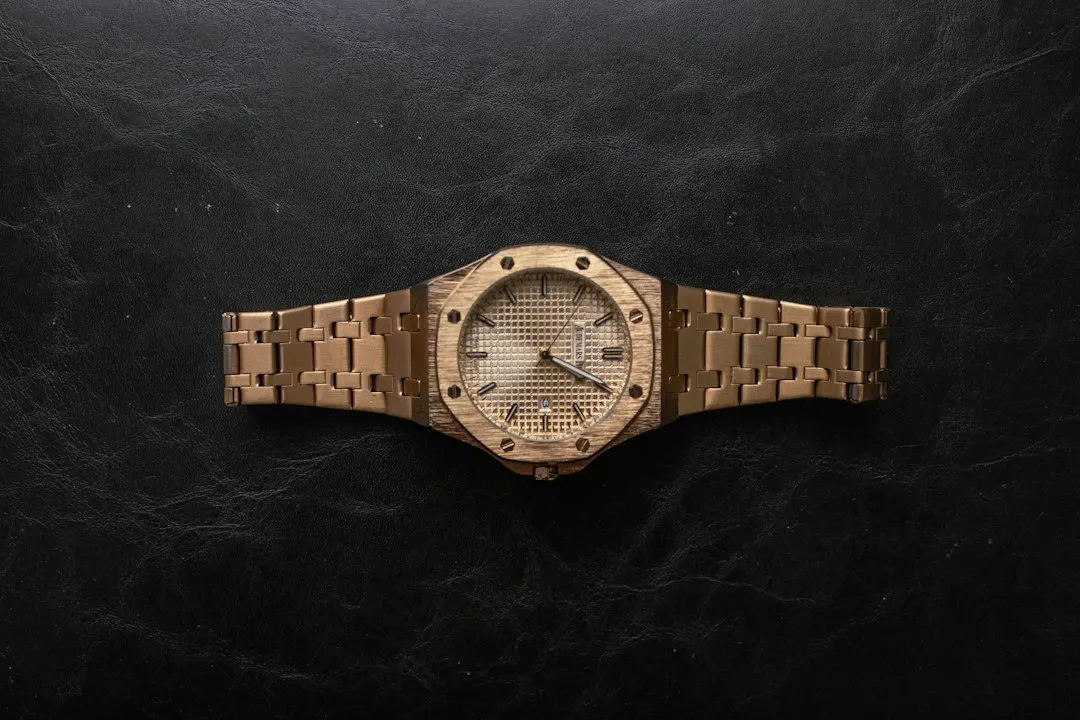
The Royal Oak’s legacy is not simply that it was different. It is that it made difference commercially and culturally viable. A steel watch with an unconventional design could sit alongside gold dress watches without apology. The model gave Audemars Piguet a design language that could be recognized instantly, and it gave collectors a new way to think about material and value.
The Royal Oak did not just give Audemars Piguet a hit; it gave the industry a new template. A watch could be sporty without being disposable, luxurious without being fragile, and recognizable without relying on a traditional round case. In 1972, that was a bet. The bet was that collectors would value design and execution as much as precious metal. That bet paid off because the watch was not a gimmick; it was a coherent object with a clear point of view. For anyone who wants to understand modern luxury sports watches, the Royal Oak is a starting point. It shows how a single reference can shift the way a brand is perceived and how a non-precious case can become as desirable as gold.
For answers to specific model questions, see the Royal Oak FAQ. For those considering their own entry into luxury watches, the same questions of material, movement, and purpose appear in choosing a first luxury watch. And if you want to test your eye for watches like this, Watchdle offers a quick game.
FAQ
What were the first Royal Oak prototypes made of?
The first prototypes were produced in white gold. They came before the steel production watch.
Where does the Royal Oak name come from?
It refers to a series of eight vessels of Britain’s Royal Navy. The name also connects to King Charles II, who hid in an ancient hollowed oak tree after the Battle of Worcester in 1651.
How did the Royal Oak’s crown change?
The original crown had a simple satin-brushed circle finish. Audemars Piguet introduced the AP monogram on the crown in the late 1990s.