Casio A168: The Full History
In this article
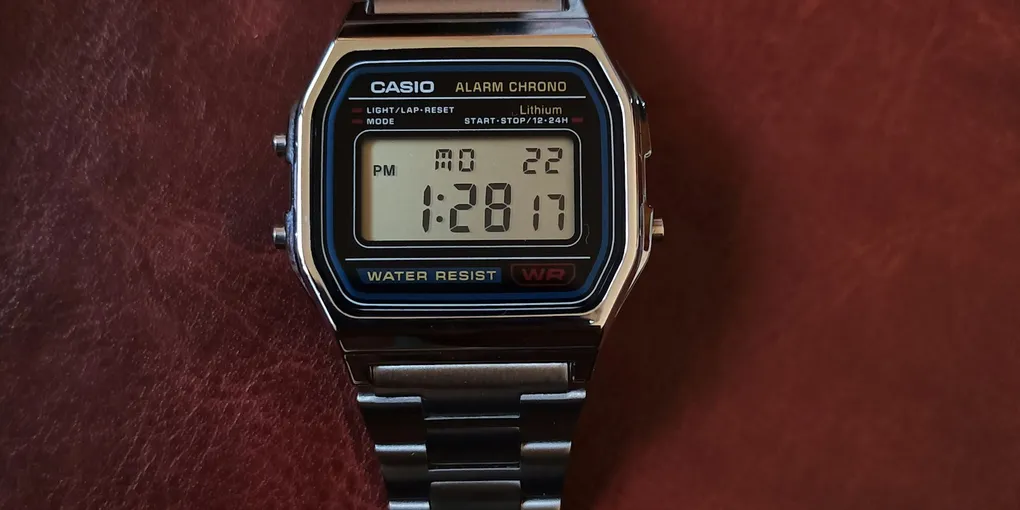
1995 was the year the Casio A168 hit the market, and if you think that makes it a relic, you are missing the point. While the rest of the watch world was obsessed with the mechanical revival of the nineties, Casio was perfecting the digital tool watch. The A168 arrived not as a luxury object, but as a refined iteration of the F-91W lineage. It took the DNA of the eighties digital boom and gave it a polish that actually lasted. It is arguably the most honest watch you can buy for under thirty dollars.
The Evolution of the Resin Aesthetic
To understand the A168, you have to look at what preceded it. Casio had spent the eighties turning the digital watch into a commodity that was virtually indestructible. The F-91W was the king of the hill, but it was purely utilitarian. The A168 brought a different energy to the table. It kept the iconic 35.5mm case diameter but swapped the resin case for a chrome-plated finish. This was a move toward the aesthetic of the seventies metal digital watches, yet it retained the lightweight, thin profile that made Casio famous.
The case is technically resin, but the plating gives it the appearance of steel without the weight. Some purists hate the “fake metal” look, but for those of us who wear these daily, it is a feature. It does not drag on your wrist. It does not scratch like a stainless steel case. It is a tool that does not pretend to be a piece of jewelry, even if the chrome finish looks decent under a cuff.
The EL Backlight Advantage
The defining feature of the A168, the one that makes it superior to its predecessors, is the Electroluminescent (EL) backlight. If you have ever tried to read an F-91W in the dark, you know the struggle. That tiny green LED on the side is practically useless. The A168 solved this by lighting up the entire screen in a crisp, even blue-green glow.
This is the module 1275 at work. It is simple, effective, and reliable. The EL backlight was a significant upgrade in 1995. It turned a watch that was relegated to daylight hours into a true 24-hour companion. When you press that light button, the entire liquid crystal display is illuminated uniformly. It is a small detail, but it changed the usability of the watch entirely. It remains one of the few instances where a functional upgrade felt like a massive leap forward without bloating the price or the size of the watch.
Design Continuity and Mass Appeal
There is no singular genius designer credited with the A168, and that is exactly how it should be. The watch is a product of Casio’s internal culture, which prioritized iterative improvement over ego-driven design. The A168 is a masterclass in ergonomics. The bracelet is a simple folded-link affair that pulls hair if you are not careful, but it is infinitely adjustable. You can slide the clasp to fit any wrist, a feature that many high-end watches still fail to get right.
The display layout is classic Casio. You have the time, the day, and the date. You have a stopwatch and an alarm. There is no bloat. There is no unnecessary tracking software or proprietary apps. It is a watch that tells you the time and keeps you on schedule. Because the design is so neutral, it has managed to stay relevant across three decades. You see it on the wrists of Silicon Valley engineers, fashion models, and people who just want a watch that works. It is the ultimate democratic timepiece.
Why the A168 Remains Essential
People talk about “heritage” in watchmaking as if it requires a Swiss pedigree and a mountain of invoices. The A168 has its own kind of heritage. It is the heritage of the Japanese electronics boom, where efficiency and accessibility were the primary goals. The watch is made in Japan, or in some cases, assembled in Casio’s global facilities using the same rigorous standards that have defined the brand since the seventies.
If you are a collector who spends thousands on mechanical movements, you should still own an A168. It is a reality check. It reminds you that a watch does not need to be complicated to be good. It just needs to be accurate, legible, and durable. The A168 is a survivor. It has outlived trends, smartwatches, and the entire mid-nineties fashion cycle. It is a piece of history that you can actually afford to bang against a doorframe without losing sleep. It is not trying to be anything other than what it is, and in the world of modern watch marketing, that is a rare commodity.
Play today’s watch at .