Breitling Top Time History: The 1960s Square Chronograph
In this article
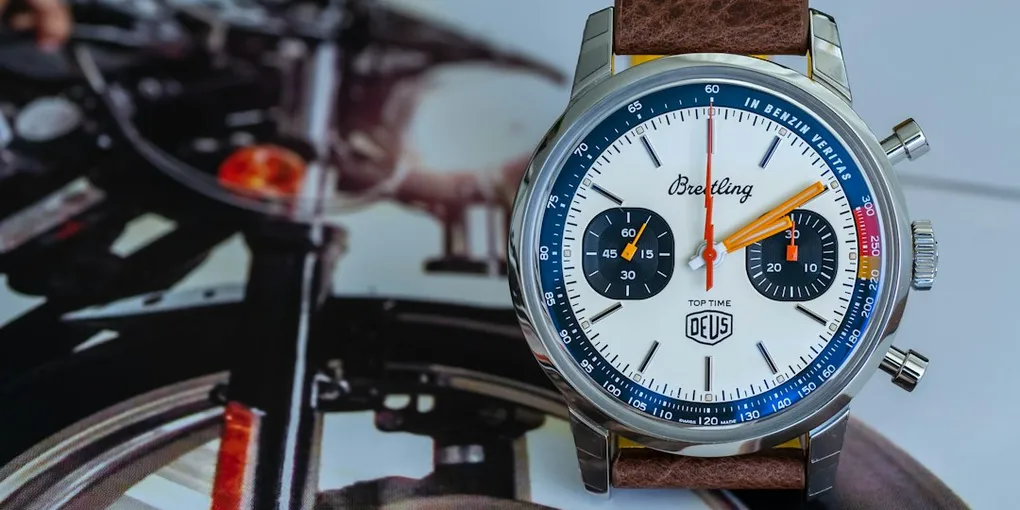
The Breitling Top Time was the chronograph Willy Breitling designed for a younger generation and introduced in 1964. It became a 1960s shape-shifter: a cushion-cased watch that adopted square cases in the years after its debut, a move that kept the line visually distinct from Breitling’s pilot-focused models.
The 1962 Design Brief and Monocoque Construction
Work on the Top Time began in 1962, two years before the watch reached the market. Willy Breitling’s brief was not to build another sober instrument for pilots or scientists. The Top Time was meant to feel approachable, colorful, and contemporary, which is why it ended up with a different case architecture from many of its stablemates.
The Top Time’s monocoque construction improved water resistance by making the case a single load-bearing element rather than a conventional caseback-and-midcase assembly. That approach suited a watch meant to be worn casually, not just kept in a display box. The chronograph had already spent decades moving from pocket stopwatches to wrist instruments, and the Top Time belongs to that broader story of how timing tools became everyday objects. For context on how chronographs moved from pocket stopwatches to wrist instruments, the broader history of the chronograph is a useful companion.
Reference Numbers and Movements: Venus 188, Venus 178, Valjoux 7733
Reference 2002 is often the first stop for collectors. It used the Cal. Venus 188, measured 35.8 mm across, and appears in records dated 1964 and 1969. Reference 2004 shared the Venus 188 and a 1964 introduction, but its case measured 36.0 mm. Those two references show how Breitling kept the Top Time compact in its earliest form, even as the dials grew more expressive.
The 810 family is more varied. The Mk1.1 ref. 810 carried the Cal. Venus 178, arrived in 1964, and measured 38.1 mm. The Mk2 ref. 810 stayed with the Venus 178 across 1967 and 1968, with cases listed at 37.8 mm and 38.0 mm. A 1969 ref. 810 with the AOPA logo used the same Venus 178 and a 38.0 mm case. The AOPA connection is a nice reminder that Breitling’s history is tangled up with aviation organizations and their members, even when the watch itself was aimed at a younger crowd.
The Sprint ref. 2000-33 took a different route with the Cal. Valjoux 7733, a 1966 date, and a 38.1 mm case. Ref. 824, also from 1969, used the Venus 178 and measured 37.8 mm. These were not enormous watches by modern standards, but their cases were large for the period, and the mix of movements shows Breitling working with the chronograph suppliers of the day. Breitling’s other great chronograph of the era, the Navitimer, went its own way with a slide rule; the Top Time was the simpler, more youth-oriented counterpoint. Contemporary rivals such as the Heuer Autavia also chased the same active, outdoor market.
Zorro Dials and Magazine Pages
Collectors gave at least one Top Time dial the nickname Zorro. The reference to the masked hero was likely a nod to the dial’s graphic layout, though the nickname stuck because it was memorable rather than official. The Top Time also appeared in the pages of Harper’s Bazaar and Vogue, a placement that underlined its position as a style-conscious chronograph rather than a pure tool. That kind of exposure mattered in the 1960s, when watch advertising was increasingly aimed at identity and aspiration.
Production Through the Mid-1970s
The line ran through the mid-1970s. By then, the watch had lived through the height of the mechanical chronograph boom and the early shocks of the quartz era. If you want to test your own eye for these 1960s shapes, the Watchdle game is a light way to do it.
FAQ
Which Breitling Top Time did James Bond wear?
James Bond wore a ref. 2002 in Thunderball (1965), and Q modified it with a Geiger counter. That makes the 2002 one of the more recognizable Top Time references despite its relatively modest dimensions.
What scale options were available on the Top Time?
The Top Time could be ordered with a tachymeter, pulsometer, or decimal outer scale. Each scale turned the same chronograph into a different kind of measuring tool, from speed to pulse rate to decimal time.
Which case materials did Breitling offer?
Breitling offered the Top Time in stainless steel, solid gold, and gold-plated versions. The range let the same design serve as a casual steel chronograph or a more formal gold watch.
What was the Top Time Long Playing?
The Top Time Long Playing was a variant with three registers, or sub-dials, for elapsed hours. That extra register made it a more capable timing tool than the standard two-register layout.
To read more about the story behind watches, try a watch history book.
Test yourself in today’s challenge at Watchdle.
As an Amazon Associate we earn from qualifying purchases.