What Is a Snowflake Watch Hand? Tudor's Signature Hands
In this article
A Snowflake watch hand is Tudor’s high-legibility dive handset, the signature design trait of the brand’s sports watches. Its guiding idea is maximum legibility through a generous application of luminescent material, and the design stretches back five decades.
A Handset Built Around Luminous Surface Area
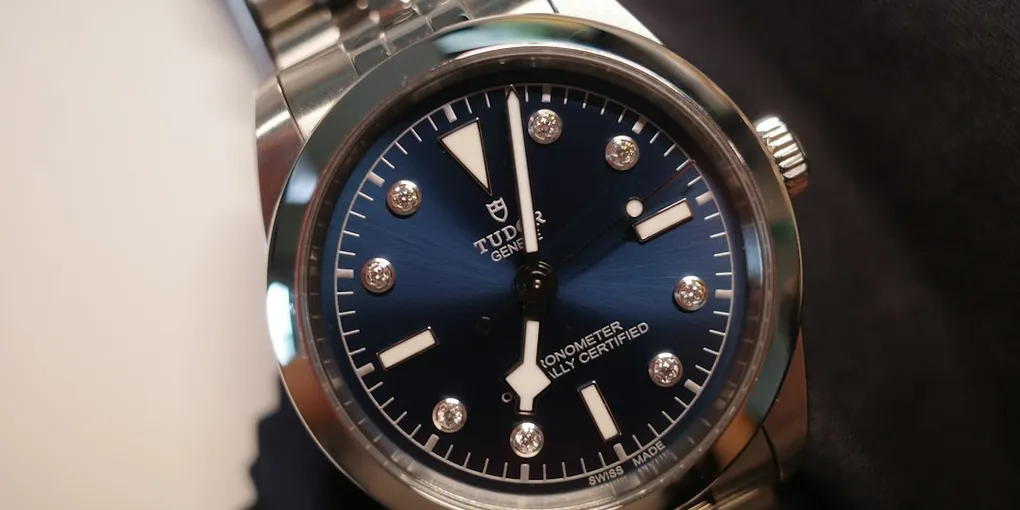
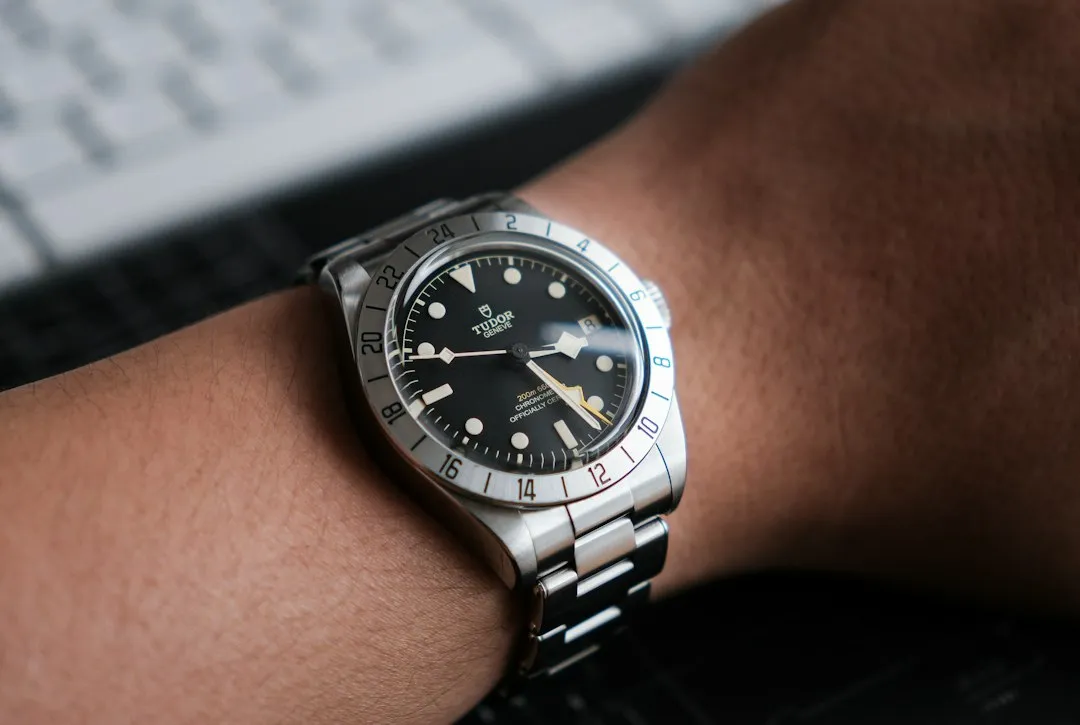
Compared with traditional Mercedes-style hands, the Snowflake layout offers a broader luminous surface area. That matters when light is poor and the dial is moving with a diver’s arm. The minute hand takes a contrasting, elongated form, so hours and minutes can be told apart at a glance. Angular hands and square hour markers helped divers quickly differentiate the hands, while also permitting greater luminescence for better visibility in murky conditions.
The logic is practical rather than decorative. A broad luminous patch is easier to see than a narrow one, especially when the watch is viewed at an angle or through stirred-up water. A diver does not need a delicate handset in a dark channel; they need to know how many minutes remain and when to turn back. The Snowflake hand answers that brief by making the luminous material the dominant visual element. If you want to go deeper into how glowing paint and modern compounds work, the story of watch lume from radium to Super-LumiNova is a useful companion. The same logic explains why lumed hands and lumed indices are often designed as a coordinated system, not separate features.
From the 1954 Submariner to the Late-1960s Snowflake
Tudor’s dive-watch story begins with the Oyster Prince Submariner, unveiled in 1954. The early reference 7922 used a 37mm case, a water resistance rating of 100 meters, a black diver’s bezel marked to 60 minutes, and a screw-down Rolex winding crown. It also used an ETA movement, a detail that separated it from its Rolex counterparts. The later reference 7928 added crown guards and raised the water resistance rating to 200 meters. These were practical steps toward a watch that could survive real underwater work, and they show how quickly Tudor was iterating on the dive-watch formula.
The second-generation Submariner arrived in 1968. Its dial paired Snowflake hands with square-shaped luminescent hour markers, and the hour hand gained a large angular tip. That tip was filled with luminous material, a choice that maximises surface area. The line included a time-only model plus a version with a date complication. The look was not a wholesale reinvention of the dive watch; it was a focused answer to one problem: making a dark dial readable in bad water. That focus is why the handset has lasted so long in Tudor’s catalog.
Why the Name “Snowflake” Stuck
Collectors gave the handset its nickname because it looked atypical. In the 1990s, the moniker was earned by the appearance of partial snowflakes in the angular shapes, especially when the luminous material and metal framing are viewed together. Tudor did not resist the label; the brand officially uses the name Snowflake hands and still uses it today. The inaugural Snowflake Submariners were also notable for another first: Tudor’s new shield logo replaced the rose logo. The name may have started as collector shorthand, but it became part of the brand’s own vocabulary. For more on how nicknames attach to watches, see this explainer on watch nicknames like Batgirl, Hulk, and Pepsi.
Naval Service and the Long Life of the Design
The Snowflake hand was not a boutique exercise. The French Navy (Marine Nationale) issued Tudor Submariners with Snowflake hands to its divers during the 1970s. Tudor Submariners went on to be used by French Navy divers up to the mid-2000s, as well as by divers from American, Canadian, and Italian navies. The Snowflake hand is associated with references such as the 9401 and 9411. After the 1980s, Tudor temporarily phased out the Snowflake design. That gap makes the modern revival more interesting: the hand disappeared from the catalog, but it never really left the memory of Tudor collectors. Naval issue gave the design a credibility no advertisement could manufacture, and the handset earned its reputation in conditions where legibility was not a luxury.
Where Snowflake Hands Live Now
Tudor brought the Snowflake hand back in 2012 as part of the newly launched Heritage Black Bay collection. On the Black Bay, the hands are a faithful recreation of the original references, even though the modern dial lacks the square hour markers of the vintage Snowflake Submariner. That handset appears on contemporary Black Bay watches regardless of model, size, material, or color. The design also spans collections: Tudor uses Snowflake hands on both the Pelagos and Black Bay lines.
To read more about the story behind watches, try a watch history book.
The Pelagos is the clearest modern expression of the tool-watch idea behind the hand. Its hour markers and hands are heavily inspired by the vintage Snowflake Submariner, and the watch pairs a 42mm titanium case with a 500-meter water resistance rating, a ceramic unidirectional bezel, and an in-house automatic movement. You can read a full breakdown in this Tudor Pelagos review, while the broader line’s evolution is traced in this Tudor Black Bay history. If you want to test your eye for Tudor details, the daily challenge at Watchdle is a natural place to spot hands, dials, and references in context.
FAQ
When did Tudor first introduce Snowflake hands?
Tudor places the Snowflake hand’s introduction year at 1969. Its first appearance was in the late 1960s on the reference 7016, followed later by the 7021.
What does the square detail on the seconds hand do?
The seconds hand has a square luminous segment near its tip. That detail confirms the watch is running.
As an Amazon Associate we earn from qualifying purchases.