Why Are Mechanical Watch Movements Decorated?
In this article
Mechanical watch movements are decorated because finishing signals craftsmanship, manufacturing philosophy, and the technical standards a watchmaker upholds—and because specific techniques can make components more durable and reliable. It is not merely an aesthetic choice.
A movement’s decoration level refers to overall quality, complexity, and extent of the finishing applied to visible and sometimes hidden surfaces. That finishing can touch plates, bridges, screws, and other components, and it ranges from simple industrial treatments to elaborate hand-finished surfaces that require many hours of skilled labour. To understand why makers spend that time, it helps to separate the decorative from the functional—though in watchmaking the two often overlap. The same questions apply across different types of watch movements.
What Counts as Movement Decoration
Decoration is the collective term for the surface treatments applied to a movement’s components. It is judged by level: how extensive the finishing is, how complex it becomes, and whether it reaches surfaces the owner will never see. A movement can be left with basic industrial treatment, or it can receive elaborate finishing that consumes many hours of skilled work. The difference is not just visual. It reflects the manufacturing philosophy of the watchmaker and the technical standards they choose to uphold.
The tradition dates back to the early days of mechanical timekeeping. In the pocket watch era, finishing techniques served practical purposes at first. Smoothing metal surfaces helped prevent rust, and finishing removed burrs created during manufacturing. Those goals were about durability and function before they were about beauty. Over time, the same operations became a way to demonstrate care, skill, and pride in the hidden mechanics.
The Pocket Watch Inheritance
Pocket watches were carried, opened, and often inspected. Their movements were not always hidden behind solid casebacks, and owners could see the plates and bridges that made the watch work. That visibility encouraged makers to treat finishing as part of the product, not an afterthought. The practical benefits remained: smoothed surfaces resisted corrosion, and manufacturing burrs were eliminated. But the growing attention to surface quality also turned the movement into a canvas for patterns and textures.
By the nineteenth and early twentieth centuries, manufacturers had introduced decorative patterns such as Geneva stripes, circular graining, and polished bevels. These were not random flourishes. They were repeatable techniques that could be applied to plates, bridges, and other components, turning raw metal into something that looked deliberate and refined.
Patterns That Became Signatures
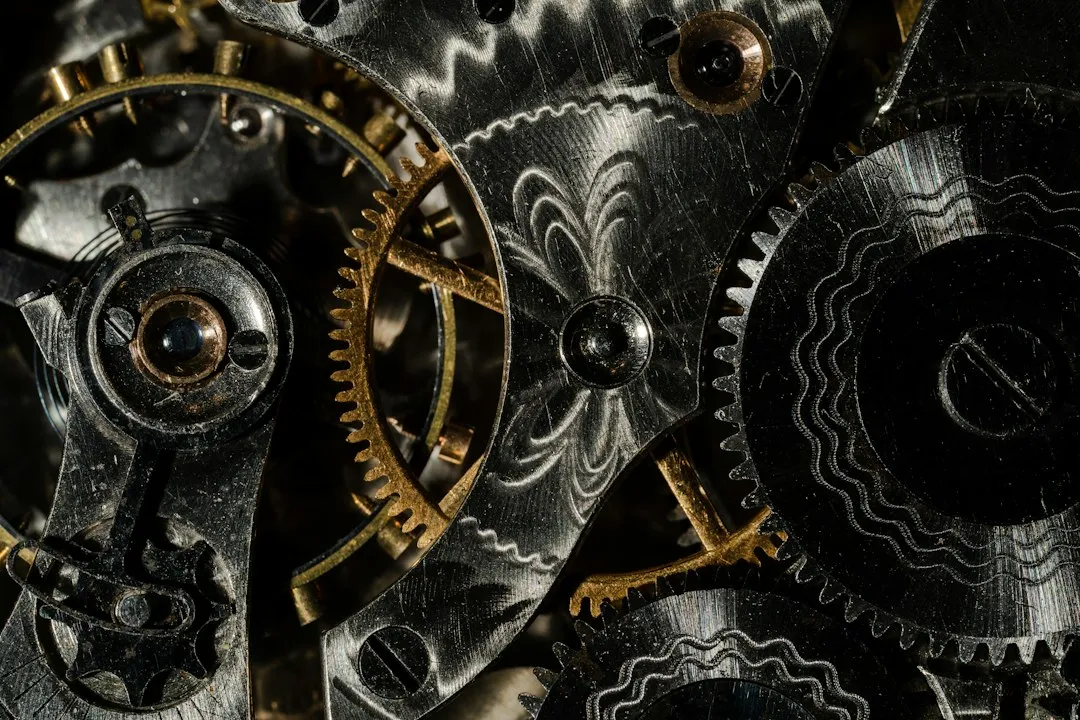
Geneva stripes, or Côtes de Genève, consist of broad parallel waves applied to the surfaces of bridges or plates. The pattern catches light in bands, making a movement look deeper and more dynamic. Circular graining is different: it consists of overlapping circular marks that create a textured surface. Beyond its appearance, circular graining helps trap microscopic dust particles away from moving parts, a small but sensible detail in a mechanical environment.
Polished bevels are another common sight. They are applied to the edges of bridges, creating a crisp line that separates surfaces and reflects light. Blued screws, created through controlled heating, add a contrasting colour and have their own technical story. Perlage, a pattern of overlapping circles, is often applied to hidden surfaces. These techniques appear frequently in decorated movements, and together they give a watchmaker’s work a recognizable visual language.
Finishing That Works Below the Surface
Not every decoration is purely cosmetic. Certain finishing techniques contribute to the longevity and reliability of movement components by smoothing surfaces and removing microscopic imperfections left from machining. That reduces friction and minimises the risk of corrosion. In a mechanism full of tiny contact points, those improvements matter. A smoothed surface or a deburred edge can mean less wear over time, even if the owner never notices the difference.
Decoration, however, does not directly influence the accuracy of a watch. A movement with exquisite finishing and a movement with plain finishing can both be accurate if they are built and regulated well. Accuracy is a separate question from surface quality, which is why a highly decorated watch is not automatically a better timekeeper. For owners concerned with accuracy, the relevant work lies in how a mechanical watch is regulated, not in the depth of its Geneva stripes.
The Machine-Hand Divide
The decoration level of a movement is influenced significantly by whether the finishing is applied by machine or by hand. Machine-applied finishing allows manufacturers to create visually appealing movements at relatively low cost. Computer-controlled tools can reproduce patterns such as Geneva stripes or circular graining with high precision, which is why these finishes appear across a wide range of watches.
Hand-applied finishing is generally regarded as the highest standard in watchmaking. It requires patience, experience, and meticulous attention to detail. Because a human hand is not a machine, hand finishing often produces subtle variations that give each movement a unique character. It also allows for more intricate techniques, such as interior angles on bevelled edges, which are difficult to achieve using automated tools. That combination of skill and individuality is why hand finishing is usually reserved for high-end or limited-production watches. The distinction between human and machine work also feeds into the broader in-house versus outsourced movement debate, where finishing is often used as evidence of a maker’s capabilities.
What Decoration Communicates to an Owner
For a collector, decoration is a readable signal. It speaks to craftsmanship, manufacturing philosophy, and the technical standards upheld by the watchmaker. A movement that has been finished on visible bridges and hidden surfaces alike suggests that the maker cared about more than the minimum required to function. That does not make the watch more accurate, but it does make the movement more expressive of the people and processes behind it.
The appeal is partly intellectual. A mechanical watch is already a small machine, and its surfaces are part of that mechanical story. When those surfaces are striped, grained, bevelled, or blued, the owner sees evidence of human decisions. The movement becomes not just a device but an object of study. If you want to test your eye for those details, Watchdle’s play page offers a quick challenge.
Why Hidden Surfaces Still Get Attention
Perlage on hidden surfaces is one of the clearest signs that decoration is not only about display. Those surfaces are rarely seen, yet they still receive a pattern. The decoration level of a movement refers to the overall quality and extent of finishing, including areas that are difficult to inspect. That approach reflects a philosophy: if a surface is part of the movement, it deserves treatment. Hidden finishing may not change how the watch performs on the wrist, but it reinforces the idea that the movement was built to a standard rather than assembled to a price.
Finishing choices tell a story about the maker’s priorities. In mechanical watchmaking, that story is often as important as the specifications on paper. Decoration does not make a watch more accurate, but it can make the mechanism more durable, more distinctive, and more rewarding to own. And for many owners, that is the point.
FAQ
Does decorating a movement make it more accurate?
No. Surface finishing is not a factor in a watch’s accuracy. Finishing is about craftsmanship and, in some cases, durability, while timekeeping depends on other mechanical factors.
Why did pocket watch makers start finishing metal surfaces?
Early finishing served practical purposes. Smoothing metal surfaces helped prevent rust and removed burrs created during manufacturing. The decorative patterns came later, building on those functional beginnings.
What separates machine-applied finishing from hand-applied finishing?
Machine-applied finishing lets manufacturers create visually appealing movements at relatively low cost, with computer-controlled tools reproducing patterns at high precision. Hand work requires patience, experience, and meticulous attention to detail, and it often produces subtle variations that give each movement a unique character.
What is the point of circular graining?
Circular graining consists of overlapping circular marks that create a textured surface. It also helps trap microscopic dust particles away from moving parts, making it both a visual pattern and a small functional aid.
To see the small details up close, a watch loupe helps.
Play today’s watch at Watchdle.
As an Amazon Associate we earn from qualifying purchases.