What Is A Fusee Watch? The Cone And Chain Explained
In this article
A fusee watch uses a cone-shaped pulley with a helical groove, wound with a cord or chain attached to the mainspring barrel, to even out the mainspring’s uneven pull so timekeeping stays more consistent. The mechanism was used from the 15th century to the early 20th century in clocks and watches.
A Helical Cone Hidden Inside The Movement
The word fusee comes from the French fusée and late Latin fusata, “spindle full of thread.” Although the part is often described as a cone, the correct shape is not a simple cone but a hyperboloid. The earliest fusees were long and slender; later examples took on a more squat, compact shape. A fusee assembly consists of a grooved cone and a fine chain.
The Spring That Would Not Pull Evenly
Springs were first employed to power clocks in the 15th century, to make them smaller and portable. Early spring-driven clocks were much less accurate than weight-driven clocks. A weight on a cord exerts a constant force to turn the clock’s wheels, while a spring’s force diminishes as it unwinds. The primitive verge and foliot timekeeping mechanism was sensitive to changes in drive force, so early spring-driven clocks slowed down over their running period as the mainspring unwound. The problem was a lack of isochronism.
Mainspring torque decreases linearly as the spring unwinds during a clock’s running period. The fusee’s tapering shape continuously changed the mechanical advantage of the pull from the mainspring, compensating for diminishing spring force. The escapement—the part that releases the wheel train one tooth at a time—was especially vulnerable to those force changes, which is why stable power mattered; the escape wheel and the tick you hear depend on a steady drive.
How The Cone And Chain Smooth The Pull
The mainspring is coiled around a stationary axle, called an arbor, inside a cylindrical box known as the barrel. The force of the spring turns the barrel. The barrel turns the fusee by pulling on the chain, and the fusee turns the clock’s gears. A gear on the fusee drives the movement’s wheel train, usually the center wheel.
When the mainspring is fully wound, all the chain is wrapped around the fusee from bottom to top, and the end going to the barrel comes off the narrow top end of the fusee. The strong pull of the wound mainspring is applied to the small end, and the torque on the fusee is reduced by the small lever arm of the fusee radius. As the clock runs, the chain is unwound from the fusee from top to bottom and wound on the barrel. More of the chain is wrapped on the barrel, and the chain going to the barrel comes off the wide bottom grooves of the fusee. The weakened pull of the mainspring is applied to the larger radius of the bottom of the fusee; the greater turning moment provided by the larger radius compensates for the weaker force of the spring, keeping the drive torque constant.
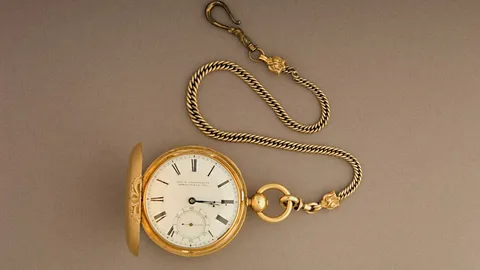
Winding a fusee clock requires a key fitted to the protruding squared-off axle, or winding arbor, of the fusee. Turning the fusee pulls the chain off the barrel and back onto the fusee, which turns the barrel and winds the mainspring. The force required to wind up the mainspring is constant; it does not increase as the mainspring tightens. This key-wound system belongs to the older world of the pocket watch and its chain, even though the fusee chain itself lives inside the movement.
Harrison, Marine Chronometers, And The Cost Of Space
Around 1726, John Harrison added the maintaining power spring to the fusee to keep marine chronometers running during winding, and this was generally adopted. The fusee and chain transmission is one of the oldest and most effective solutions in horology for addressing the inconsistencies in a mainspring’s power output. It has a rare but respected place in modern wristwatches.
To read more about the story behind watches, try a watch history book.
That place comes with a trade-off. The mechanism needs space for the cone, the chain, and additional gears, so watches containing a fusee and chain are often thicker and broader. English watchmakers historically favored the fusee and chain as a robust solution. If you enjoy identifying classic mechanisms and other watch details, the daily puzzle at Watchdle offers a playful way to sharpen that eye.
From Chamber Clocks To Pocket Watches
The Burgunderuhr, or Burgundy clock, is the earliest existing clock with a fusee and the earliest spring-powered clock. It was a chamber clock made for Philip the Good, Duke of Burgundy, about 1430, and it is preserved in the Germanisches Nationalmuseum. Fifteenth-century drawings by Filippo Brunelleschi and Leonardo da Vinci also show fusees.
Fusees became the standard method of getting constant force from a mainspring, used in most spring-wound clocks and watches when they appeared in the 17th century.
FAQ
Did Jacob Zech invent the fusee?
The origin of the fusee is not known. Many sources erroneously credit Jacob Zech of Prague with inventing it around 1525, but the earliest definitively dated fusee clock was made by Jacob Zech in 1525. The earliest known example of the fusee concept is a crossbow windlass shown in a 1405 military manuscript.
What was the stackfreed?
The stackfreed and the fusee appeared with the first spring-driven clocks. The stackfreed was a crude cam compensator that added a lot of friction and was abandoned after less than a century. The fusee proved a much more lasting idea.
Were fusee cords always chains?
No. Original fusee cords were made of gut, or sometimes wire, and chains began to be used around 1650 because they lasted longer. Gruet of Geneva is widely credited with introducing fusee chains in 1664, although the first reference to a fusee chain dates to around 1540. Fusees designed for cords had circular cross-section grooves, while fusees designed for chains had rectangular-shaped grooves.
How can you recognize a verge fusee pocket watch?
The verge fusee pocket watch was the standard watch of the 18th century; look for key winding, a pierced balance cock, a silver regulator disc, a deep movement, and often a pair case. Key winding is through the back or the dial; the pierced balance cock is often engraved; the silver regulator disc has numbers; the deep movement is thick, with pillars; and the pair case is an inner and outer case, sometimes with watch papers between. The verge escapement is the oldest escapement, with a crown wheel pushing two pallets on the balance staff controlled by the balance wheel, while Dutch forgeries are continental verge watches of the 18th century signed with false English, usually London, names to borrow English prestige.
As an Amazon Associate we earn from qualifying purchases.