Omega Railmaster History: 1957 Anti-Magnetic Tool Watch
In this article
The Omega Railmaster is the anti-magnetic tool watch Omega launched in 1957 for railway workers, engineers, technicians, and scientists who dealt with electrical currents. It began as a shielded field instrument and evolved into a modern collection with far greater magnetic resistance.
A Trilogy Arrives: Railmaster, Speedmaster, Seamaster 300
The Railmaster did not appear alone. Omega placed it inside a professional trilogy that also included the very first Speedmaster and the Seamaster 300. That grouping matters because it frames the Railmaster as a specialist rather than a general-purpose watch. The Railmaster took a different route: it was for magnetic places, not racetracks, cockpits, or ocean floors. In a catalog, that meant three watches with three distinct missions, and the Railmaster was the one aimed at industrial and scientific environments.
The model is also catalogued as the Omega Seamaster Railmaster, and it shared the same professional intent: it was designed for those who worked in environments with strong magnetic fields. In the late 1950s, that was not an abstract concern. Electrical work, rail systems, laboratories, and industrial settings could expose a mechanical watch to magnetic fields that pulled its rate off course. The Railmaster was Omega’s answer: a watch that did not merely look rugged but was engineered around a specific hazard. Its appeal was narrow by design. It was not trying to be a dress watch or a sports watch for every occasion. It was a tool for people whose jobs made magnetic resistance a real requirement. The result was a watch that solved a problem rather than chased a trend.
Inside the CK2914: A Faraday Cage on the Wrist
The reference at the heart of the early Railmaster story is the CK2914. Omega protected its movement with a soft iron inner case, creating a Faraday cage. That architecture gave the watch magnetic resistance up to 1,000 gauss. The protective inner case around the movement was not a small detail; it was the reason the watch existed. Where a conventional mechanical watch might be affected by a strong magnetic field, the Railmaster was built to keep its movement insulated from that influence. The solution was elegant in principle: surround the movement with a material that redirects magnetic energy, so the delicate internals remain undisturbed. It is the kind of engineering that is easy to describe and difficult to execute in a watch case that still has to fit on a wrist. That is why the CK2914 remains the purest expression of the Railmaster idea.
Other makers pursued similar goals. The Rolex Milgauss history is a useful companion read, because it shows how deeply anti-magnetic engineering shaped professional watch design. But the Railmaster’s solution was its own: a soft iron cage wrapped around the movement, simple in concept and demanding in execution. For a broader explanation of the problem, see How To Keep Your Watch Demagnetized.

The Original Railmaster’s Purposeful Dial and Case
The original Railmaster was built around a robust stainless-steel case. Its dial was black, with luminous hands and indices for low light. Large Arabic numerals and triangular markers at the quarters gave it a legible, instrument-like face. A screw-down crown helped complete the tool-watch brief. Inside was Calibre 284, a manual-wind movement. Together, those choices created a watch that looked like what it was: a piece of equipment.
Nothing about the design was ornamental. The black dial, luminous paint, and bold markers were there to make the time readable in working conditions. The stainless-steel case and screw-down crown acknowledged that the watch would be worn, not stored. Even the marker layout—large Arabic numerals and triangles at the quarters—reads as a practical response to a working environment. This was a watch meant to be read at a glance and trusted for the job at hand. It did not rely on precious metals or fragile details. Its beauty, if you want to call it that, came from the clarity of its purpose. The result was a watch that communicated its purpose before you ever read a spec sheet.
A Quiet Exit and a 2003 Comeback
The Railmaster did not remain in continuous production. Omega discontinued it in the 1960s. For decades, the name sat dormant while the Speedmaster and Seamaster lines carried Omega’s professional-watch reputation forward. That changed in 2003, when the Railmaster was reintroduced as part of the Seamaster Aqua Terra line. The return was not a simple reissue. It was a reintroduction into a very different watch market, one where automatic movements and broader size choices were the norm.
The revived watch used automatic movements and was offered in 36, 39, and 42mm sizes. It was a different era and a different market, but the return showed that Omega still saw value in the anti-magnetic idea. The 2003 models were not carbon copies of the CK2914. They were modern watches with automatic movements, produced in a range of sizes that reflected changing tastes. Yet the name carried the memory of the original tool watch, and that memory gave the revival a clear identity. The revival kept the name alive, but the original remains the reference point.

The Railmaster’s Quiet Place in Omega’s Tool Watch Line
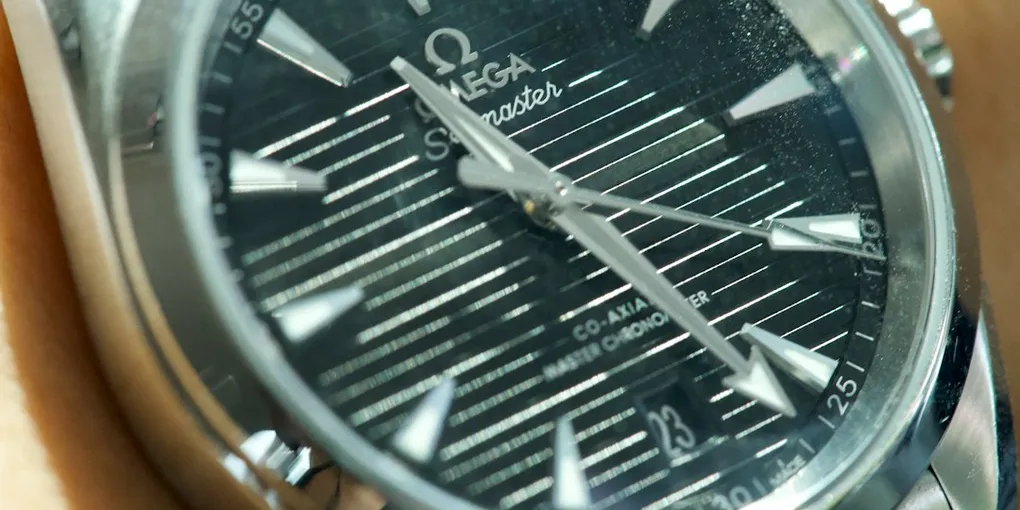
The modern collection continues that anti-magnetic mission, now with Omega’s Co-Axial technology. The Co-Axial escapement is part of what separates the current generation from the manual-wind original. The brief has not changed: a stainless-steel tool watch designed for magnetic environments. What has changed is the scale of the protection and the engineering behind it. The name Railmaster still signals a watch built for people who work around magnetic fields, even if the technology inside has moved on.
The Railmaster’s history is not as loud as the Speedmaster’s or as deep as the Seamaster 300’s. It does not have a moon landing or a saturation-diving record attached to its name. Its story is quieter and more specific. It is about a watch made for people who worked around electrical currents and magnetic fields, and about a problem that Omega solved with a soft iron cage. That makes it one of the clearest examples of a tool watch: a design with a single, practical purpose, executed without decoration. In an era when many watches are sold on lifestyle and status, the Railmaster’s origin remains stubbornly functional. If you want to test your recall of watch stories like this one, Watchdle offers a quick quiz at Watchdle.
FAQ
How much magnetic resistance does the modern Railmaster offer?
The modern Railmaster is rated to 15,000 gauss.
What movement powers the current Railmaster?
The current Railmaster uses the Co-Axial Master Chronometer Calibre 8806. The Small Seconds version uses Calibre 8804.
What are the current Railmaster’s case size and material?
The current model comes in a 38 mm stainless-steel case and meets Master Chronometer standards.