Why Do Some Watch Straps Have Quick Release Pins?
In this article
Quick release pins exist to make swapping a watch strap a hand-operated task rather than a bench job. The tiny mechanism lets the wearer change a strap without reaching for a dedicated tool, and that convenience reshapes how a watch can be worn, shared, and personalized.
The Metal Tube Inside Every Traditional Strap
A standard spring bar is a small metal tube containing a coil spring, with two pins protruding from its ends. Spring tension pushes those pins outward, locking them into the watch’s lug holes and holding the strap in place. It is a remarkably effective piece of miniature engineering, relying on pressure and geometry rather than screws or clasps. The system has survived because it works. It also has a practical downside.
Removing a standard spring bar requires a small forked tool—a spring bar tool—to compress the bar and slip it out of the lug holes. The process is not difficult, but it demands attention. The fork can slip and scratch the lugs of the watch. That risk is why many people avoid changing straps as often as they might like. A lug that meets a steel fork at the wrong angle can pick up a mark that no amount of careful wiping will remove. For a detailed method, the steps are covered in How To Remove Watch Bracelet Pins At Home.
Why The Old System Still Persists
The standard spring bar remains common because it is simple, compact, and proven. Its pins lock into the lug holes with spring tension, so the strap is held securely without extra hardware. The trade-off is accessibility. The tool needed for removal is small enough to lose and sharp enough to cause damage. That combination explains why quick release systems found an audience. They do not replace the spring bar’s basic job. They add a more human interface to it.
A Spring Bar With Its Own Release Catch
A quick release spring bar is a normal spring bar with an extra small lever or knob built into the side of the bar near one end. Pushing that lever retracts the pin without a tool. The idea is almost mischievous in its simplicity: the spring bar already knows how to release; it just needed a button. A quick release strap goes a step further by building a small lever directly into the spring bar itself, housed within the strap material. Sliding it with a thumbnail retracts the bar so the strap lifts straight out.
You are not fighting the spring. You are asking it to let go. That distinction is what makes the system feel different in the hand. Instead of bracing the watch and working a fork into a tight space, you flip the watch over, find the lever, and slide. The strap comes free with a gentle pull. The same motion in reverse installs the next strap. If you are selecting a strap for the first time, the fit begins with the watch’s lug spacing, a topic explained in Watch Lug Width Guide: How To Measure For Straps.
The Lever Is Part Of The Bar, Not An Add-On
Because the release mechanism lives inside the spring bar and, on some straps, inside the strap material, it does not dangle or rattle. It is not a separate clasp or a removable adapter. The bar still spans the lugs. The pins still secure the strap. The only difference is that one end can be retracted by thumb rather than by tool. That integration matters for anyone who values a clean look. The hardware remains hidden in normal use, and the strap keeps its original profile. The release is there when you need it, invisible when you do not.
Why The Strap Stopped Being Permanent
Quick-release mechanisms made it easy for users to swap out straps without needing tools, allowing them to adapt watches to different occasions, outfits, and preferences. That sentence describes a small mechanical change, but it also describes a shift in ownership. A watch strap became an accessory that could be changed and personalized rather than a permanent part of a timepiece. Before that, a strap change was a deliberate project. Afterward, it became a decision you could make while standing in front of a mirror.
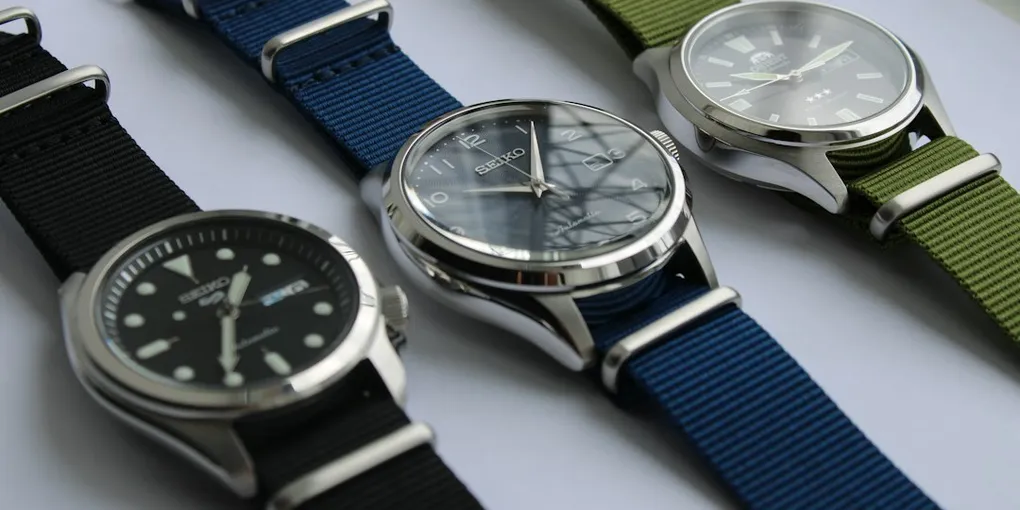
The watch itself no longer had to commit to one identity. A single case could wear leather for a formal dinner, canvas for a weekend walk, or something else entirely for a trip. This is the same logic that makes a two-watch collection satisfying: one dress piece and one sport piece can cover more ground than their number suggests, as explored in Dress Watch Vs Sport Watch: Building A Two-Watch Collection. Quick release turns that logic into a daily option rather than a planned event.
Personalization Without A Workbench
The emotional effect is easier to notice than the mechanical one. When a strap is hard to remove, it tends to stay on. The watch becomes fixed in a particular mood. When the strap can be released by hand, the watch becomes more experimental. You might try a color you would never have committed to permanently. You might move a favorite strap between two watches. You might pack a second strap because it takes up almost no space. None of this requires a new watch. It requires only the willingness to pull a small lever.
The Quiet Convenience Of A Hand-Operated Swap
There is a broader pattern in watch design where small conveniences remove daily friction. A quick-set date is one example: it spares the owner from endless crown turning just to reach the right number. The same spirit appears in Quick-Set Date: A Modern Convenience. Quick release pins belong to that family. They do not make a watch more accurate or more waterproof. They make it more usable in the moment. That usability is easy to underestimate until you own a watch that has it. The difference is not dramatic in a photograph. It is dramatic in a routine. You finish work, you want a different look, and the change takes less time than finding your keys. The watch stays the same. The relationship changes.
A Small Mechanism With A Large Personality
For resizing or swapping a strap, a strap replacement kit covers the basics.
A quick release pin does not announce itself. It hides in the hardware and waits. But it changes the calculus of strap ownership. A strap is no longer a commitment. It is a choice. That choice can be reversed in seconds, which encourages experimentation. For collectors, that is often the beginning of a deeper interest in how watches look and feel beyond the case and dial. The mechanism is tiny. The effect is not. If you enjoy matching watches to straps as a mental exercise, the game at https://watchdle.com/play/ is a low-stakes way to test those instincts.
FAQ
Where does the quick release lever sit when the watch is on my wrist?
It sits on the underside of the strap, between the strap and the watch case, and is invisible during normal wear. That placement keeps the release out of sight while leaving it accessible when you flip the watch over.
How fast is a quick release swap?
A quick release spring bar strap swap takes about 20–30 seconds. A quick release strap change can take about ten seconds. Those figures are the practical payoff of the built-in lever.
What else do quick release straps make easier besides the swap itself?
They eliminate the need to carry tools or visit a watch shop for strap changes. They also minimize the risk of accidental scratches or damage to the watch case because there is no need to manipulate the watch case directly. And they minimize the need to stretch or stress the strap during removal or attachment, which can result in a longer lifespan.
As an Amazon Associate we earn from qualifying purchases.