Seiko 6105 History: Willard, Uemura, Vietnam
In this article
The Seiko 6105 was Seiko’s second dive watch after the 1965 62MAS, made from 1968 to 1977 in two distinct versions, and its reputation rests on three things: US military use in Vietnam, Naomi Uemura’s solo journeys, and Martin Sheen wearing a 6105-8110 as Captain Willard in Apocalypse Now. It is the bridge between the brand’s first professional diver and the asymmetrical case design that collectors now call the Willard.
From 62MAS To Two 6105 Generations
Seiko entered the dive watch arena with the 62MAS in 1965. The 6105 followed as Seiko’s second diver, and it stayed in production from 1968 through 1977. That long run split into two clearly different watches. The first generation, built from 1968 to 1970, used a symmetrical case with an offset crown at 4 o’clock. Its model numbers were 6105-8000 and 6105-8009, the latter being the US model. This is the slimmer case that collectors separate from the later design.
The second version arrived as the 6105-8110 or 6105-8119. In Seiko’s generations, the 6105-811X was the third-generation diver following the 6217—better known as the 62MAS—and the slimmer 6105-8000/9. The 6105-811X production years were 1970 to 1977. For a broader view of how these references sat inside Seiko’s dive watch lineage, the 6105 occupies the space between the 62MAS and the professional divers that followed.
The Asymmetrical Case And Crown
The 6105-8110 is the shape most people picture when they hear “Seiko 6105.” Its stainless steel case has an asymmetrical cushion form, with the crown at 4 o’clock protected by large, bulging crown guards. The watch measures about 44mm wide by 47mm long, with 19mm lugs. A specific 6105-8110 from March 1972 measures 44mm in diameter, 47mm lug to lug, 13mm thick, and weighs 90g.
That crown is one of the model’s signatures. It is roughly 6.3mm wide and uses a turn-and-lock system unique to this reference. It is not a screw-down crown. Instead, it works as a bayonet system: push down and twist to lock. The crown is signed with the word Lock and an arrow showing the direction to turn. It locks into position with a small pin fitting into indents, preventing it from turning. Original factory finishing combined circular brushing on top with polishing on the sides. The watch was water-resistant to 150m, which made sense for a tool meant to be worn hard. If you want to understand why crown guards and bezel action matter on a diver, what actually matters in a dive watch is a useful companion.
Dial, Bezel, And Crystal
The bezel is a coin-edge design with an aluminum insert. It rotates bi-directionally and provides 60 clicks in a full rotation. The crystal is Seiko’s proprietary hardened mineral glass, Hardlex, in a double-domed form.
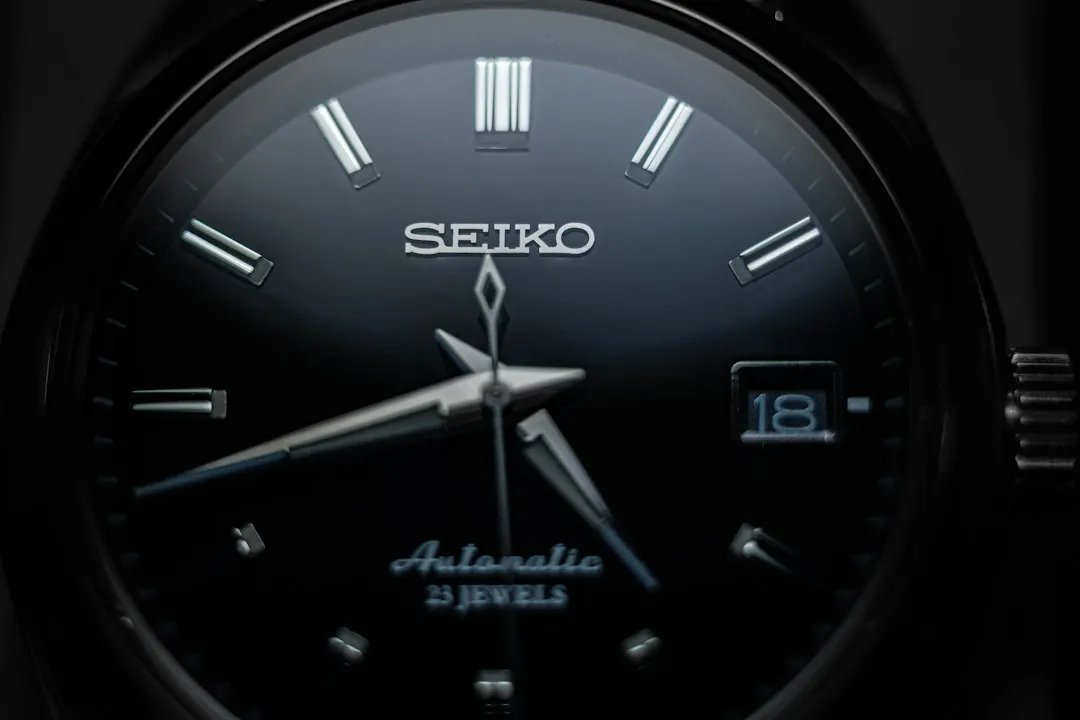
The dial is matte black, with raised applied chrome markers filled with Seiko’s lume material. On the 6105-8110, the hour markers are rectangular, with a raised flat metal contour around the luminous fill. A date window sits at 3 o’clock with a chrome frame. Under 12 is an applied chrome Seiko logo, with Automatic printed below it. The chapter ring is black, and the fine print below 6 reads Japan 6105-8009T. The hour and minute hands are lume-filled faceted steel batons. The second hand is the detail that gives the watch much of its character: a stop-light style with two lume-filled holes at the tip, distal white lume and proximal pale red. That traffic-light pip is specific to this model, and the whole package reflects the evolution of the dive watch from tool to icon.
Vietnam, PX Stores, And The Willard
The 6105 became a popular choice with US military servicemen during the Vietnam war era, and it was available from PX stores. US servicemen in Vietnam were issued field watches made by American brands such as Hamilton and Benrus, but some purchased watches from PXs on base. The 6105-8110 was among those PX purchases. Its 150m water resistance suited the jungles of Vietnam, and the watch became famous among American troops.
Price mattered, too. According to Seiko catalogues from the period, the 6105-8110 retailed for $95. In 1970, US enlisted personnel earned between $133 and $903 per month depending on rank and length of service, so this was not a trivial purchase.
The military connection fed directly into the watch’s most famous film appearance. In Apocalypse Now, Martin Sheen’s character Captain Benjamin Willard wears a 6105-8110. The watch was chosen for Sheen’s character because of its popularity amongst servicemen in the real world. That association gave the reference the nickname Captain Willard, from the 1979 film. It is the kind of detail that makes a watch instantly recognizable, and recognition games such as Watchdle thrive on exactly that.
Uemura And The Other Nickname
The 6105-8110 has a second nickname: Uemura. It comes from Japanese explorer Naomi Uemura, who wore the watch during a 12,000km solo dog-sled run from Greenland to Alaska. His choice was not influenced by sponsorship or an ambassador deal, which makes the connection more compelling for collectors. The nickname also references Uemura’s solo arrival at the North Pole on 1 May 1978. Between Willard and Uemura, the 6105-8110 carries two distinct stories: one cinematic, one expeditionary. That blend of character carried into later Seiko divers, a lineage visible in the SKX007 story.
FAQ
What movement powered the Seiko 6105?
It used the caliber 6105B, a 17-jewel full-rotor automatic. It beats at 21,600 bph, has a 46-hour power reserve, cannot be hand wound, hacks, and includes a quick-set date.
What do the final digits in 6105-8110 and 6105-8119 indicate?
The last digit indicates the market where the watch was originally sold. The two references share the same generation, but 6105-8110 and 6105-8119 were not identical in their intended distribution.
Did the Seiko 6105 come on a bracelet?
No. The original configuration was a rubber strap.
Why do some 6105 dials say PROOF while others say RESIST?
Early 1970 models used water 150m proof on the dial and waterproof on the case back. Later 1970 models switched to water 150m resist and water resistant on the back. By 1972, most dials had gotten rid of PROOF entirely.