Grand Seiko 44GS History: 1967 Grand Seiko Style
In this article
The Grand Seiko 44GS, introduced in late 1967, is widely considered the progenitor of the classic Grand Seiko look and the model that set the trend of Grand Seiko Style for decades of Seiko watches.
Its story starts not with a Grand Seiko but with Daini Seikosha. That division was shut out of producing Grand Seiko models in favor of in-house competitor Suwa Seikosha. Rather than wait, Daini set about producing their own high-end model, the King Seiko. The 4420A, introduced in 1964 as a King Seiko, is known today as the 44KS. That watch became the foundation for the Grand Seiko 44GS, which derived from the King Seiko 44KS rather than from an existing Grand Seiko. The 4420B appeared in 1967 as a Grand Seiko with the legendary 44GS case. The 44GS was accepted into a three-watch Grand Seiko model lineup in 1967 with a revised case, turning a rival division’s high-end project into a defining Grand Seiko reference.
A Revised Case Enters the Grand Seiko Lineup
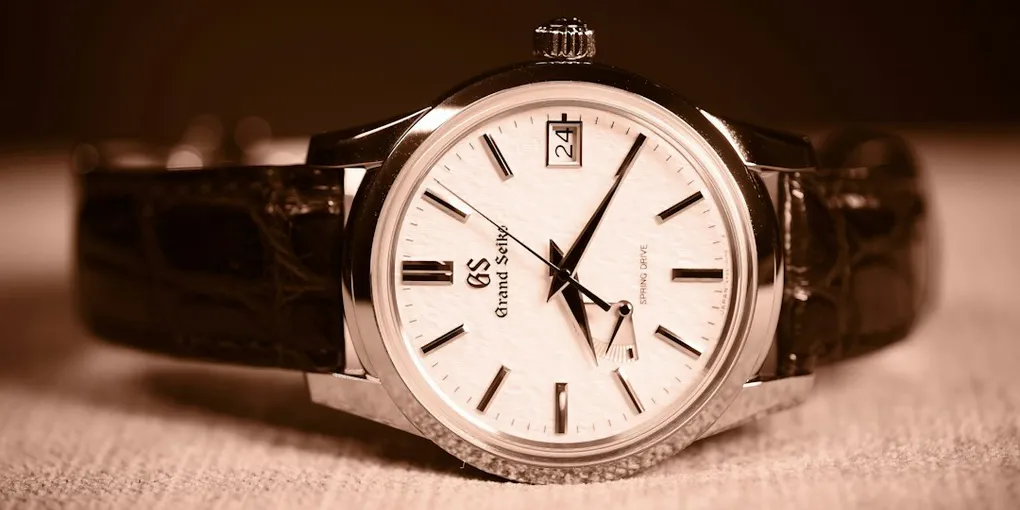
The 44GS and the Grand Seiko 62GS appeared in late 1967, selling alongside the venerable 57GS for a year. The 57GS was the predecessor; the 45GS would follow as the successor. But the 44GS’s revised case gave the lineup a new architectural voice. It was not a busy watch. There was no date window or other complications. The dial was white with applied indexes, and the functions were limited to hours, minutes, and central seconds. That austerity made the case the star. The 44GS was only available in stainless steel, with a screw-back case and 50 m of water resistance. It was manually-wound and beat at 18,000 A/h. Those choices place it firmly in its era, before automatic winding and quartz rewrote the expectations of everyday watchmaking. For a later contrast in how movements changed the conversation, see Automatic Vs Quartz: The Real Difference. The 44GS did not need a complication to justify its presence; its geometry did the talking.
Seiko’s broader design language often carries across categories and decades. The Seiko Alpinist: From Laurel to the SARB Era shows another line with a long visual memory. The 44GS belongs to the same broad tradition, but its role was more foundational for Grand Seiko itself. It arrived as a focused mechanical object at a time when the brand’s identity was still being negotiated between divisions.
Price, Position, and a Two-Year Run
The stainless steel version, the 4420-9000/44GS 020, cost 24,000 Yen. That figure was 3,000 Yen below the outgoing steel 57GS and 11,000 Yen lower than the contemporary 62GS. In the late-1960s lineup, the 44GS was therefore the more accessible expression of the new case design, even if it was still a high-end hand-wound mechanical watch from Seiko. Accessibility did not buy it a long life. The 44GS lasted just two years. It was phased out in favor of the Daini-produced Grand Seiko 45GS in 1969. Its production years were 1967-1969, a short window that makes its later reputation all the more striking. The successor, the 45GS, took over the catalog path, but the 44GS had already planted its design flag.
A Template Beyond Its Production Run
Seiko remade the 44GS in 2013 in two forms: a same-size remake and a larger-cased concept with a sapphire back. The same-size version kept the original proportions in conversation, while the larger-cased concept offered a modern reading with a sapphire back. Neither remake changes the historical record of the original. Instead, they confirm that the 44GS operates on two levels: a short-lived late-1960s watch and a long-lived design source.
Later Grand Seiko chapters would explore very different mechanics, from the Grand Seiko Spring Drive: The Movement With No Tick to dials like the Grand Seiko Snowflake: Quiet Perfection. The brand’s technical story also moved through quartz and GPS, as traced in Seiko Astron GPS Solar: The Full History. The 44GS belongs to the earlier moment when the visual identity was fixed. If you enjoy spotting how references survive across generations, the daily game at Watchdle is a natural companion to that kind of looking.
FAQ
What was the Grand Seiko 44GS derived from?
The 44GS derived from the King Seiko 44KS, not from a Grand Seiko. That King Seiko began as the 4420A, introduced in 1964.
Why did Daini Seikosha produce the King Seiko?
Daini Seikosha was shut out of producing Grand Seiko models in favor of in-house competitor Suwa Seikosha. Daini responded by producing its own high-end model, the King Seiko.
How did the 44GS compare in price to its contemporaries?
The stainless steel 4420-9000/44GS 020 cost 24,000 Yen. It was 3,000 Yen below the outgoing steel 57GS and 11,000 Yen lower than the contemporary 62GS.
What did Seiko do with the 44GS in 2013?
Seiko remade the 44GS in two forms: a same-size remake and a larger-cased concept with a sapphire back. These remakes revisited the original’s case design.