Watch Auctions: How They Work and Why Records Break
In this article
Watch auctions work by concentrating a small number of rare, well-documented watches into a competitive sale, and prices keep breaking records because the best examples combine scarcity, provenance, and historical weight. The $31 million, $24 million, and $17.75 million results are not market averages; they are trophies that reflect a tiny supply and a determined group of bidders.
How a Watch Auction Turns a Reference Into an Event
At a high level, an auction house assembles a catalog, sets estimates, and runs a sale where bidders compete until the hammer falls. For watches, the catalog is the argument: it explains what the piece is, why it matters, and how many others might exist. A Patek Philippe Stainless Steel Ref. 1518 is a perfect example. It is the first perpetual calendar chronograph ever produced in series, and only four known examples exist. That combination of a technical first and extreme scarcity is what turns a wristwatch into an auction event.
The same logic applies to condition and originality. A watch that has survived decades without being over-polished or badly restored will attract bidders who care about the details. The complication itself—the chronograph—is mechanical, and understanding how a chronograph actually works helps explain why collectors treat certain references as engineering landmarks rather than simple accessories.
The Records That Define the Market
Patek Philippe Grandmaster Chime Ref. 6300A-010
The highest result in this group is the Patek Philippe Grandmaster Chime Ref. 6300A-010, which sold for $31 million at Geneva’s 2019 Only Watch charity auction. A charity auction can concentrate attention on a single lot, and when that lot is a Patek, the result can detach from ordinary market logic. The number matters because it sets a ceiling that other complicated Pateks are measured against, even if no ordinary sale is likely to approach it.
The Henry Graves Supercomplication
The Patek Philippe Henry Graves Supercomplication sold for $24 million at Sotheby’s Geneva in 2014. It was commissioned by New York banker Henry Graves Jr. in 1925, took eight years to complete, and has 24 complications. That is a 1925 commission, a decade-scale project, and a complication count that still sounds absurd. Its auction price is less about telling time than about owning a piece of horological history.
Rolex Daytona “Paul Newman” Ref. 6239
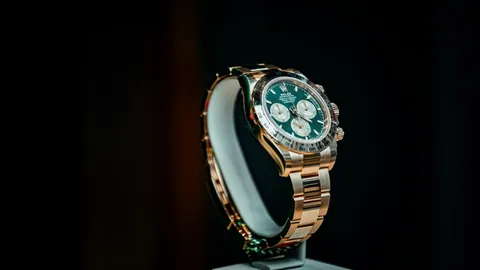
The Rolex Daytona “Paul Newman” Ref. 6239 sold for $17.75 million at Phillips New York in 2017. Its caseback inscription—“Drive Carefully Me.”—is the kind of detail that turns a watch into a story. Daytonas are chronographs, and chronographs have long been the most legible kind of mechanical complication for collectors. The Newman connection and the inscription give bidders something beyond the reference number.
Patek Philippe Stainless Steel Ref. 1518
The Patek Philippe Stainless Steel Ref. 1518 sold for $11.14 million at Phillips Geneva in 2016. Only four known examples exist, and it is the first perpetual calendar chronograph ever produced in series. Stainless steel is often less precious than gold, but rarity and historical significance can override material. Four known examples means the auction is not a test of demand for the model; it is a test of who wants the model most.
Rolex Daytona “Unicorn” Ref. 6265
The Rolex Daytona “Unicorn” Ref. 6265 sold for $5.9 million at Phillips Geneva in 2018. It is white gold and was born in 1970. The “Unicorn” nickname and the white-gold case distinguish it from the standard Daytona conversation. At this level, buyers are paying for configuration, rarity, and the confidence that the watch is exactly what it is claimed to be.
Grand Seiko and Urwerk
Not every record belongs to Patek or Rolex. A one-of-a-kind Grand Seiko Kodo Constant Force Tourbillon sold for $478,000, a world record price for any Grand Seiko. It is also the brand’s first mechanical complication watch. Grand Seiko’s broader technical reputation includes innovations like Spring Drive, and the Kodo shows that collectors are willing to pay for Japanese watchmaking when the piece is singular enough.
Meanwhile, the Urwerk UR-102.02 Time for Art sold for $403,200, a new world record for any Urwerk wristwatch. That result shows that independent and unconventional watches can set records within their own universes, even when they are not competing with the biggest Patek results.
Why Phillips Keeps Showing Up in Record Headlines
Phillips has been the first auction house in history to hit a two-year 100% success rate in watch sales. Its December 10-11 New York Watch Auction: SEVEN totaled $21.1 million, and its watch auction earnings this year were $51.5 million, a record for the Americas. Those numbers explain why the auction house’s name appears so often in record stories. A high success rate means consignors can trust the room, and a strong total means the room has enough depth to support serious bidding. When a sale works, it becomes a self-reinforcing event: better watches attract better bidders, and better bidders produce better prices.
What Actually Drives Prices Higher
The records above are not random. They share a few traits: scarcity, provenance, condition, brand significance, and a story that can be told in a catalog. Scarcity is obvious in the Patek Philippe Stainless Steel Ref. 1518 with four known examples. Provenance is obvious in the Henry Graves Supercomplication, commissioned by a named New York banker, and in the Rolex Daytona “Paul Newman” Ref. 6239 with its “Drive Carefully Me.” inscription.
Condition matters because auction buyers are often paying for originality they cannot easily restore. Brand significance matters because Grand Seiko’s Kodo is the brand’s first mechanical complication watch, and the Urwerk UR-102.02 Time for Art set a new world record for any Urwerk wristwatch. Mechanical craftsmanship matters too: the record-setters here are mechanical watches, not quartz, which is why collectors still debate the real difference between automatic and quartz and why accuracy alone is not the point. A mechanical watch can be less accurate than a quartz watch and still be worth more because the value is in the mechanism, the history, and the difficulty of making it. That is also why mechanical accuracy is a separate conversation from auction value.
How to Read an Auction Result Without Getting Fooled
A record price is a headline, not a price list. The $31 million Patek Philippe Grandmaster Chime Ref. 6300A-010 does not mean every Patek is worth millions. The $24 million Henry Graves Supercomplication does not mean every complicated Patek will find a bidder at that level. The $17.75 million Rolex Daytona “Paul Newman” Ref. 6239 and the $5.9 million Rolex Daytona “Unicorn” Ref. 6265 are exceptional Daytonas, not the baseline for the model. The $403,200 Urwerk UR-102.02 Time for Art is a record for Urwerk, not for watches in general. The $478,000 Grand Seiko Kodo is a world record for Grand Seiko, not a signal that every Grand Seiko will appreciate forever.
The useful questions are simpler: How many exist? Who owned it? Is it original? Does it represent a first, a last, or a turning point? For the Patek Philippe Stainless Steel Ref. 1518, the answer is four known examples and the first perpetual calendar chronograph ever produced in series. For Grand Seiko, the Kodo is the brand’s first mechanical complication watch, and Grand Seiko was the first Japanese watch to be chronometer-rated to Swiss standards. Those are the details that separate a record from a merely expensive watch.
If you want to test your own eye for those details, the game at Watchdle turns watch spotting into a quick daily challenge. It is a useful reminder that auction results are built on specifics, not vibes.
FAQ
Why did the Patek Philippe Grandmaster Chime Ref. 6300A-010 sell for $31 million?
It sold at Geneva’s 2019 Only Watch charity auction for $31 million. That is the highest auction sale price in the facts here, and it shows how a charity auction can concentrate demand on a single Patek Philippe.
What makes the Henry Graves Supercomplication historically important?
It was commissioned by New York banker Henry Graves Jr. in 1925, took eight years to complete, and has 24 complications. It sold for $24 million at Sotheby’s Geneva in 2014.
Are all Rolex Daytona auctions worth millions?
No. The Rolex Daytona “Paul Newman” Ref. 6239 sold for $17.75 million at Phillips New York in 2017, and the “Unicorn” Ref. 6265 sold for $5.9 million at Phillips Geneva in 2018. Those are exceptional examples, not the typical Daytona.
What do Phillips’ results say about the watch auction market?
Phillips was the first auction house in history to hit a two-year 100% success rate in watch sales. Its December 10-11 New York Watch Auction: SEVEN totaled $21.1 million, and its watch auction earnings this year were $51.5 million, a record for the Americas.